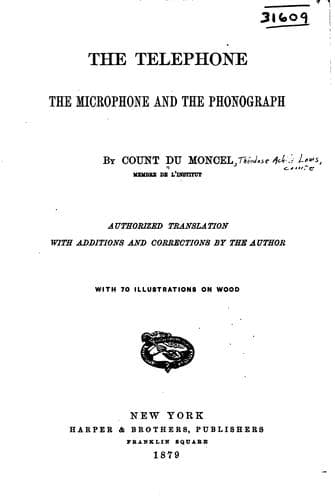
The telephone, the microphone & the phonographDu Moncel, Th., comte
History
The telephone, the microphone & the phonograph
Du Moncel, Th., comte
Microphone; Phonograph; Telephone
When the circuits are altogether metallic, there is much less risk of
confusion, and M. Zetzche declares that sounds proceeding from other
wires are in this case little heard, and then only momentarily, so that
it is much more easy to hear with this arrangement than with the one in
ordinary use. ‘It is not,’ he says, ‘the resistances of the wire, but
rather the diversions of the current near the posts, which interfere
with telephonic correspondence on long lines above ground. This was
proved by the following experiments:--I connected the telegraphic line
from Dresden to Chemnitz with a line from Chemnitz to Leipzig (54
miles), which made a circuit of 103 miles, going to earth at its two
extremities. There was no communication between Dresden and Leipzig,
but Leipzig and Dresden could communicate with ease, in spite of the
greater extent of line. I broke the connection with earth, first at
Leipzig, then simultaneously at Leipzig and Dresden, and I observed
the following effects. When insulation took place at Leipzig only,
the telephone could be heard at the stations of Dresden, Riesa, and
Wurzen; when the line was insulated at both ends, the communication was
good between the two latter stations, but it was observed that at the
intermediate station the words spoken at Wurzen were more distinctly
heard than the words spoken at Riesa were heard at Wurzen. Since the
distance from Wurzen to Leipzig is little more than half that from
Riesa to Dresden, there are consequently nearly twice as many posts
on the latter line, which carry the currents to earth, and hence I
conclude that these diversions of current explain the possibility
of conversing on an insulated line, and also why sounds are more
distinctly heard at the Riesa station in consequence of the greater
intensity of current still remaining on the line.’
Some vibrations also result from the action of currents of air on
telegraphic wires, which produce the humming sound so well known on
some lines, and these may also react on the telephone; but they are
in this case generally mechanically transmitted, and they may be
distinguished from the others, if the sounds which ensue are heard
after the telephone is excluded from the circuit by a break with a
short circuit and after the communication to earth established behind
the telephone has been broken.
Public-domain text, read in full here on John Shaqi.
Reviews
Reviews
No reviews yet
Be the first to share your thoughts on this work.
Elsewhere in the archive
Join the Discussion
Join the discussion
Sign in to leave a comment or review.
Sign InorCreate an account