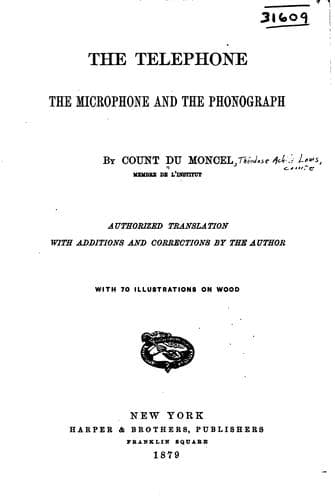
The telephone, the microphone & the phonographDu Moncel, Th., comte
History
The telephone, the microphone & the phonograph
Du Moncel, Th., comte
Microphone; Phonograph; Telephone
In order to put the second mode in practice, Mr. Preece says that
it would be necessary to study the two kinds of induction which are
developed on telegraphic lines: electro-static induction, analogous
to that produced on submarine cables, and electro-dynamic induction,
resulting from electricity in motion. In the former case, Mr. Preece
proposes to interpose between the telephone wire and the other wires a
conducting body in communication with the earth, capable of becoming a
screen to the induction by itself absorbing the electro-static effects.
He says that this might be accomplished by surrounding the telegraphic
wires adjacent to the telephonic wire with a metallic envelope, and
then plunging them in water. He adds that the effects of static
induction are not completely destroyed in this way, since the substance
used is a bad conductor, but they are considerably reduced, as he
has proved by experiments between Dublin, Holyhead, Manchester, and
Liverpool. In the second case, Mr. Preece admits that an iron envelope
might paralyse the electro-dynamic effects produced by absorbing them,
so that if insulated wires were employed, covered with an iron case,
and communicating with the earth, the two induced reactions would be
annulled. We will not follow Mr. Preece in his theory as to these
effects--a theory which seems to us open to question, but we content
ourselves with pointing out his proposed mode of attenuation.
In order to carry out the third expedient, it might be thought that it
would be enough to employ a return wire instead of going to earth, for
under such conditions the currents induced on one of the wires would be
neutralised by those resulting from the same induction on the second
wire, which would then act in an opposite direction; but this mode
would only be successful when there is a very small interval between
the two telephone wires, and they are at a considerable distance from
the other wires. When this is not the case, and they are all close
together, as in submarine or subterranean cables, consisting of several
wires, this mode is quite inefficient. A small cable, including two
conductors, insulated with gutta-percha, may be successfully carried
through the air.
The use of two conductors has the further advantage of avoiding the
inconvenience of stray currents on the line and through the earth,
which, when the communications to earth are imperfect, permit the line
current to pass more or less easily into the telephonic line.
Public-domain text, read in full here on John Shaqi.
Reviews
Reviews
No reviews yet
Be the first to share your thoughts on this work.
Elsewhere in the archive
Join the Discussion
Join the discussion
Sign in to leave a comment or review.
Sign InorCreate an account