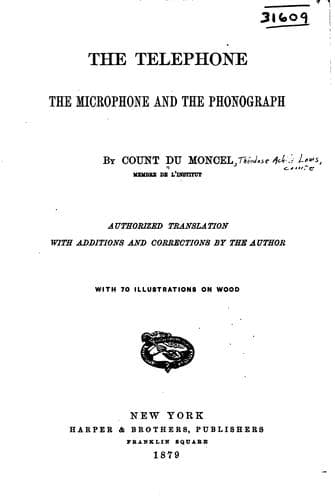
The telephone, the microphone & the phonographDu Moncel, Th., comte
History
The telephone, the microphone & the phonograph
Du Moncel, Th., comte
Microphone; Phonograph; Telephone
In addition to the disturbing causes in telephonic transmission we have
just mentioned, there are others which are also very appreciable, and
among them are the accidental currents which are continually produced
on telegraphic lines. These currents may proceed from several causes,
at one time from atmospheric electricity, at another from terrestrial
magnetism, at another from thermo-electric effects produced upon the
lines, at another from the hydro-electric reactions produced on the
wires and disks in communication with the earth. These currents are
always very unstable, and consequently they are likely, by reacting
on the transmitted currents, to modify them so as to produce sounds
upon the telephone. Mr. Preece asserts that the sound proceeding
from earth currents somewhat resembles that of falling water. The
discharges of atmospheric electricity, even when the storm is remote,
produce a sound which varies with the nature of the discharge. When
it is diffused and the clap takes place near at hand, Dr. Channing,
of Providence, U.S., says that the sound resembles that produced by a
drop of fused metal when it falls into water, or, still more, that of
a rocket discharged at a distance: in this case it might seem that the
sound would be heard before the appearance of the flash, which clearly
shows that the electric discharges of the atmosphere only take place in
consequence of an electric disturbance in the air. Mr. Preece adds that
a wailing sound is sometimes heard, which has been compared to that of
a young bird, and which must proceed from the induced currents which
terrestrial magnetism produces in the metallic wires when placed in
vibration by currents of air.
M. Gressier, in a communication made to the Académie des Sciences on
May 6, 1878, has spoken of some of these sounds, but he is totally
mistaken in the source to which he ascribes them.
‘In addition to the crackling sound caused by the working of telegraph
instruments on the adjacent lines, a confused murmur takes place in the
telephone, a friction so intense that it might sometimes be thought
that the vibrating disk was splitting. This murmur is heard more by
night than by day, and is sometimes intolerable, since it becomes
impossible to understand the telephone, although nothing is going on
in the office to disturb the sound. The same noise is heard when only
one telephone is used. A good galvanometer inserted in the circuit
reveals the presence of sensible currents, sometimes in one direction,
sometimes in another.’
Public-domain text, read in full here on John Shaqi.
Reviews
Reviews
No reviews yet
Be the first to share your thoughts on this work.
Elsewhere in the archive
Join the Discussion
Join the discussion
Sign in to leave a comment or review.
Sign InorCreate an account