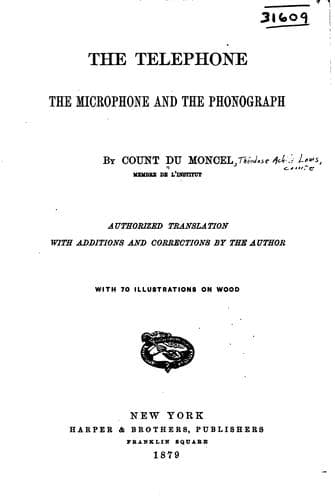
The telephone, the microphone & the phonographDu Moncel, Th., comte
History
The telephone, the microphone & the phonograph
Du Moncel, Th., comte
Microphone; Phonograph; Telephone
In spite of the difficulties attending its use, the experiment was
made by the Russians in the late war: the cable wire of communication
was 500 or 600 yards long, and so light that it could be laid by one
man. The ‘Telegraphic Journal’ of March 15, 1878, states that the bad
weather did not interfere with the working of the instruments; but the
noise made it difficult to hear, and it was necessary to cover the head
with a hood to intercept external sounds. This cannot be considered a
satisfactory result, yet the telephone may be of great service to an
army by intercepting the enemy’s messages: a bold man, provided with a
pocket telephone, who placed himself in a retired spot, might divert
the current of the enemy’s telegraphic wire into his telephone, and get
possession of all his despatches, as we saw was the case at Clermont.
He might even do this by diverting the current to earth or to a rail of
the railway line. These are suggestions for future research, and it is
probable that they may some day be turned to practical account.
_Its application to the navy._--The telephone may be of the greatest
use in naval matters, for the service of electro-semaphores, for
island forts and ships at anchor. M. Pollard says that ‘experiments
made between the Préfecture Maritime at Cherbourg, the semaphores and
the forts on the mole, demonstrate the advantage there would be in
establishing telephones at these stations, since they would ensure an
easy communication between the vessels of a squadron and the land they
are approaching. By sinking small cables which come to the surface
of the water along mooring chains, and terminate in buoys or cases
which remain permanently in the harbour, the ships of war may in this
way place themselves in communication with the Préfecture Maritime as
they cast anchor, and, by temporarily connecting the vessels together
with light cables, the admiral may communicate freely with the whole
squadron.’
The telephone has been tried on board ship for transmitting orders, but
without success, on account of the noise always going on in a vessel.
The telephone may be usefully applied to the service of submarine
torpedoes. We have already seen how it may be applied in connection
with the microphone, but it may also be used in firing the torpedoes
after the exact position of the enemy’s ship has been ascertained from
two reconnaissances taken from different parts of the coast.
The telephone, again, makes it possible to verify the condition of
torpedoes, and to ascertain if there is any fault in the circuit within
the explosives. For this purpose a very weak current has been used,
and a galvanometer is not always able to indicate the fault, while the
extreme sensitiveness of the telephone will do so in the simplest way.
Public-domain text, read in full here on John Shaqi.
Reviews
Reviews
No reviews yet
Be the first to share your thoughts on this work.
Elsewhere in the archive
Join the Discussion
Join the discussion
Sign in to leave a comment or review.
Sign InorCreate an account