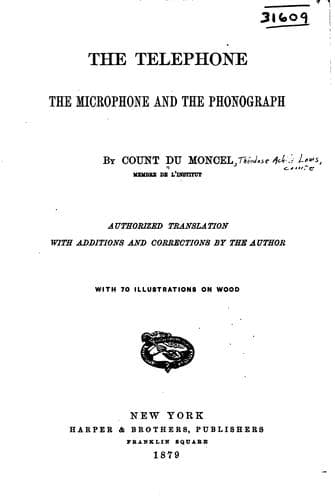
The telephone, the microphone & the phonographDu Moncel, Th., comte
History
The telephone, the microphone & the phonograph
Du Moncel, Th., comte
Microphone; Phonograph; Telephone
Captain M’Evoy, of the American Army, suggested a way of ascertaining,
while on shore, the condition of torpedoes under water, by connecting
the buoys which support them with the land by means of a telephonic
line. By inserting, in the buoy which supports the torpedo, metallic
disks, so arranged as to vibrate with every movement caused by the
waves upon the buoy, a continuous noise will be heard in the telephone,
after the circuit has been completed by the metallic disks; and the
noise will go on as long as the disks continue to oscillate, and will
cease as soon as the buoy is completely covered by the water. When it
ceases, therefore, if not affected by some accidental cause, it may be
supposed that the enemy’s ship is passing over the buoy.
M. Trève, again, has shown that the telephone might be used with
advantage for the telegraphic communication between vessels in tow, and
M. des Portes has applied it with good effect to diving operations. In
this instance, one of the glass panes in the helmet is replaced by a
copper plate in which the telephone is framed, so that the diver need
only make a slight movement of his head in order to receive or address
communications to those in charge of the apparatus. With this system
the keels of vessels may be examined, and an account given of their
condition, without bringing up the divers, which has hitherto been
necessary.
M. de Parville, the able and learned editor of the _Journal
Scientifique_ and the science department of the _Journal des Débats_,
has suggested a new and interesting application of the telephone. It
concerns the possibility of making use of it to determine the precise
position of the magnetic meridian, that is, the true direction of the
magnetised needle.
For this purpose a Bell telephone is necessary, of which the
magnetic core is formed of an iron rod a mètre in length, kept, by
a suitable suspension, at nearly the same angle of inclination as a
dipping-needle. This rod will be magnetised under the influence of
terrestrial magnetism, and the telephone will be able to transmit
the sounds produced by some sort of vibrator placed near its
mouthpiece. These sounds will be strong in proportion to the degree
of magnetisation of the bar; and if the telephone is turned round the
horizon, keeping the bar at the same angle of inclination, the sounds
transmitted to the receiving telephone will be greatest when the axis
of the bar is in the plane of the magnetic meridian, and least when
it is at 90°. It will therefore be possible to ascertain from the
direction of the axis at the moment when the sounds are no longer
heard, the exact inclination of the magnetic needle from north to
south, for it will be given by the perpendicular to the line which is
followed by the axis of the iron bar at that moment.
Public-domain text, read in full here on John Shaqi.
Reviews
Reviews
No reviews yet
Be the first to share your thoughts on this work.
Elsewhere in the archive
Join the Discussion
Join the discussion
Sign in to leave a comment or review.
Sign InorCreate an account