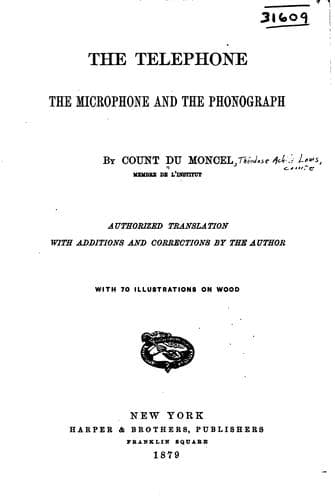
The telephone, the microphone & the phonographDu Moncel, Th., comte
History
The telephone, the microphone & the phonograph
Du Moncel, Th., comte
Microphone; Phonograph; Telephone
It is possible that, with this system, the disturbing influence on the
magnetic needle of the mass of iron in iron-plated vessels might be
almost destroyed, and a more exact orientation than that of the compass
might be obtained. The same process may make it possible to estimate
and measure the variations of terrestrial magnetism. M. de Parville has
not himself tried to apply this system; but Mr. Blake’s experiments, of
which we spoke in an early part of this work, make it probable that it
might be done with advantage.
_Application to industry._--One of the earliest and most important
applications of the telephone is that which was first made to the
service of mines in England and America in the autumn of 1877. The
great length of the galleries is well known, and had already involved
the use of the electric telegraph for transmitting orders; but the
miners did not understand how to work these instruments, and the
service was ill performed. Thanks to the telephone, through which the
first corner can send and receive a message, there is no longer any
difficulty in the communication between the galleries and the surface
of the mine.
The ventilation of mines can also be regulated by the aid of
telephones. If one of these instruments is placed near a wheel kept
in motion by the air which passes through the ventilating shaft, and
another is placed in the inspector’s office he can ascertain by the
sound if the ventilation is duly carried on, and if the machine works
regularly.
_Application to scientific research._--M. d’Arsonval’s experiments,
which we have already mentioned, show that the telephone can be used
as an extremely sensitive galvanoscope; but since it can only produce
sounds under the influence of broken currents, the circuit on which the
experiment is made must be divided at rather close intervals. It has
been seen that it is not even necessary to insert the telephone in the
circuit: it may be influenced, when at a distance, either immediately
or by the induction of the broken current on a circuit placed parallel
to the first, and the force of these effects may be increased by the
reaction of a core of iron, round which the inducing circuit is wound.
The drawback to this system is that the direction of the current is
not ascertained, so that it cannot be used as a measuring instrument;
but, on the other hand, it is so sensitive, so easy to arrange, and so
inexpensive, that it might be of the greatest use as a galvanoscope.
Public-domain text, read in full here on John Shaqi.
Reviews
Reviews
No reviews yet
Be the first to share your thoughts on this work.
Elsewhere in the archive
Join the Discussion
Join the discussion
Sign in to leave a comment or review.
Sign InorCreate an account