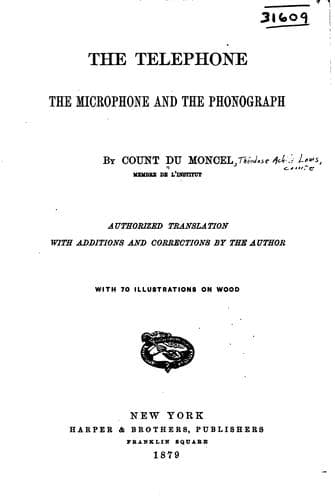
The telephone, the microphone & the phonographDu Moncel, Th., comte
History
The telephone, the microphone & the phonograph
Du Moncel, Th., comte
Microphone; Phonograph; Telephone
Mr. Warren de La Rue has also made use of the telephone in his
researches into the electric discharges of high-tension batteries,
in order to follow the different phases of the discharge during the
luminous phenomena which it produces. In this way he ascertained
that when a condenser is placed in connection with a battery formed
of a considerable number of insulated elements, and is gradually
discharged through a Geissler tube, a dull and faint sound is heard
in the telephone, as long as the stratifications of light appear to
be perfectly stable; but the sound becomes considerably stronger,
and sometimes even piercing, in proportion to the diffusion of these
stratifications, and to their approach to the point of extinction:
whence it is shown that the discharge of a battery into tubes in which
a vacuum has been made is intermittent.
Mr. Spottiswoode has repeated the same experiments with the discharges
of Holtz machines, and with large condensers, and he found that the
most piercing sounds produced by the telephone coincided with the
greatest development of the stratifications. These sounds, however,
sometimes ceased for a moment. It was even possible to ascertain,
from the intensity of the sounds produced, the differences of tension
which might be manifested in the charge of the condenser and the
slackening of the machine’s motion, and the differences of intensity
in these sounds might in some cases exceed an octave. The fall in the
scale generally appeared in half-tones instead of gradually, and the
introduction of resistances into the circuit modified the sounds very
much: they might even be intensified by approaching the finger to the
discharging tube.
From experiments made with the telephone between Calais and Boulogne,
it appears that this instrument might be applied with advantage to the
science of projectiles. In fact, in some artillery practice which took
place on the shore at Boulogne, a telephone was placed close to the
gun, and the explosion was heard at a distance of nearly two miles,
where the projectile fell. It was possible to estimate its velocity by
measuring the lapse of time between the moment when the projectile left
the gun, and its fall. This calculation is usually made by observing
the flash from the cannon’s mouth; but in some cases, as in a fog or in
practice at long ranges, the telephone may be usefully substituted for
ocular observation. On the field of battle, an observer, provided with
a telephone and placed on a hill, might rectify from a distance the aim
of his battery, which is generally established in a sheltered and less
elevated place.
THE PHONOGRAPH.
Public-domain text, read in full here on John Shaqi.
Reviews
Reviews
No reviews yet
Be the first to share your thoughts on this work.
Elsewhere in the archive
Join the Discussion
Join the discussion
Sign in to leave a comment or review.
Sign InorCreate an account