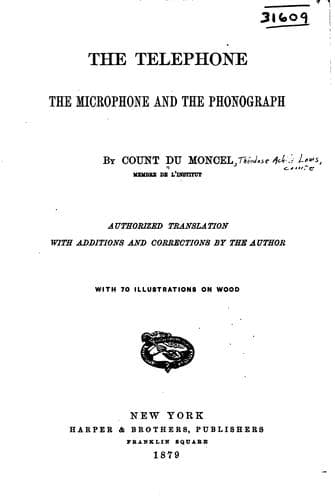
The telephone, the microphone & the phonographDu Moncel, Th., comte
History
The telephone, the microphone & the phonograph
Du Moncel, Th., comte
Microphone; Phonograph; Telephone
Mr. Edison’s Phonograph, which has for the last year attracted so much
attention, is an instrument which not only registers the different
vibrations produced by speech on a vibrating plate, but reproduces the
same words in correspondence with the traces registered. The first
function of this instrument is not the result of a new discovery.
Physicists have long sought to solve the problem of registering
speech, and in 1856 Mr. Leo Scott invented an instrument well known to
physicists under the name of Phonautograph, which completely solved
the difficulty: this instrument is described in all the more detailed
treatises on physics. But the second function of the Edison instrument
was not realised nor even mentioned by Mr. Scott, and we are surprised
that this able inventor should have regarded Mr. Edison’s invention as
an injurious act of spoliation. We regret on his own account, since no
one has wished to deprive him of the credit he deserves, that he should
have published a pamphlet on the subject, couched in terms of such
asperity, which proves nothing, and only states facts which were well
known to all physicists. If any other person could claim the invention
of the phonograph, at least in its most curious property of reproducing
speech, it would certainly be M. Charles Cros; for in a sealed paper
deposited at the Académie des Sciences, April 30, 1877, he pointed
out the principle of an instrument by means of which speech might be
reproduced in accordance with the marks traced on a register like that
of the phonautograph.[19] Mr. Edison’s patent, in which the principle
of the phonograph is first indicated, is dated July 31, 1877, and he
was still only occupied with the repetition of the Morse signals. In
this patent Mr. Edison described a mode of registering these signals by
means of indentations traced with a stylus on a sheet of paper wound
round a cylinder, and this cylinder had a spiral groove cut on its
surface. The tracings thus produced were to be used for the automatic
transmission of the same message, by passing it again under a stylus
which should react on a current breaker. In this patent, therefore,
nothing is said of the registration of speech or of its reproduction;
but, as the ‘Telegraphic Journal’ of May 1, 1878, observes, the
foregoing invention gave him the means of solving this double problem
as soon as it was suggested to him. If we may believe the American
journals, this suggestion soon came, and it was the result of an
accident.
Public-domain text, read in full here on John Shaqi.
Reviews
Reviews
No reviews yet
Be the first to share your thoughts on this work.
Elsewhere in the archive
Join the Discussion
Join the discussion
Sign in to leave a comment or review.
Sign InorCreate an account