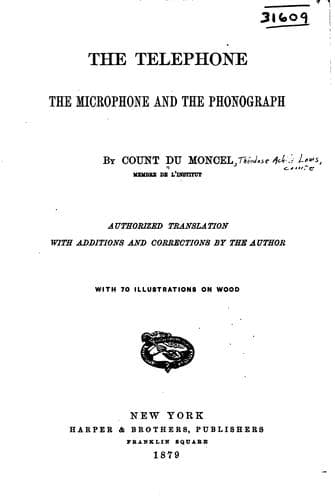
The telephone, the microphone & the phonographDu Moncel, Th., comte
History
The telephone, the microphone & the phonograph
Du Moncel, Th., comte
Microphone; Phonograph; Telephone
In another arrangement M. Courtot’s mirror telephone has been employed,
and a sort of spring pedal is inserted in the wood of the mouthpiece,
which terminates in a bent silver wire, supporting an index adapted
to make a contact with a square plate soldered to the diaphragm. The
battery is placed in connection with the spring of the pedal, and
one end of the telephone coil-wire communicates as before with the
diaphragm. When a call is to be made, the pedal must be pressed, and
the battery immediately communicates with the silver wire which, with
the diaphragm, constitutes the vibrator, and an electric vibration
is sent through the circuit, and produces the call. For receiving,
the pedal is allowed to revert to its normal position, and the index
of the pedal, touching the contact in connection with the diaphragm,
establishes direct communication between the two telephones, while
breaking the contact of the silver wire with the diaphragm, so that the
battery cannot act.
It appears that experiments made at the musketry school at Orleans for
a distance of 370 miles have been very successful.
_M. Varey’s Microphone Speaker._--M. Varey has recently arranged
a successful microphonic speaker, in which the principle of the
microphone represented in fig. 39 is maintained. The system of three
vertical carbons is arranged inside a sort of snuff-box, of which the
lid is made of a thin plate of mica, horn, or ebonite. The snuff-box
is provided with two hinged arms, so that it may be placed in the
most convenient position for speaking, and at the same time the
sensitiveness of the instrument can be regulated. A small battery,
consisting of two Gaiffe cells of chloride of silver, is placed in the
pedestal on which the instrument stands, and sets the microphone at
work without further trouble. In this way the speaker can be used like
an ordinary telephone, and is not affected by vibrations of air. Only
vibrations of sound react upon it.
_Microphonic Speaker by Fitch._--Mr. Pope states that this speaker
has produced excellent results in America. It is merely Edison’s
carbon telephone reduced to its simplest form. It consists of a small
cylindrical box, which has a mouthpiece like the one represented
fig. 28. The box contains two carbon disks of the same diameter as
itself, and is lined with a kind of felt. Metal wires, inlaid in a
groove scooped on the circumference of the carbons, place them in
communication with the circuit and battery, and transmission takes
place by means of the vibrations of the upper carbon, which is directly
influenced by the voice without the intervention of any diaphragm.
These vibrations, which can be freely developed in consequence of the
elasticity of the felt pad which supports the lower carbon, produce
on the surface of contact of the two carbons the modifications of
intensity of current necessary for the reproduction of speech, in the
same way as other microphones.
Public-domain text, read in full here on John Shaqi.
Reviews
Reviews
No reviews yet
Be the first to share your thoughts on this work.
Elsewhere in the archive
Join the Discussion
Join the discussion
Sign in to leave a comment or review.
Sign InorCreate an account