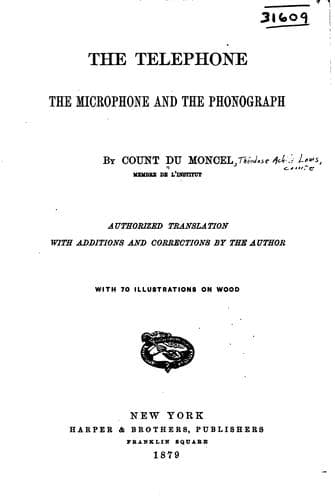
The telephone, the microphone & the phonographDu Moncel, Th., comte
History
The telephone, the microphone & the phonograph
Du Moncel, Th., comte
Microphone; Phonograph; Telephone
An induction coil is necessarily employed for a long circuit, and
the effects of induction in the adjacent wires are modified by two
rheostats introduced into the circuit at its two extremities.
_Further remarks on the theory of the Telephone._--Following the
example of a certain sceptic in the Académie des Sciences, Colonel
Navez continues to maintain the theory first formed as to the mode
in which the telephone acts, in spite of the clearest proofs of its
insufficiency; but most scientific men who consider the question have
come round to our opinion, and admit the concurrence of several causes
in the reproduction of speech by this remarkable instrument. Mr.
Fleeming Jenkin writes to this effect in the new edition of a treatise
on Electricity and Magnetism.
He observes that a singular fact has been discovered by several
persons, who have ascertained that not merely non-magnetic and
non-conducting bodies can be substituted for the diaphragms of
receiving telephones, but that they will act without a diaphragm at
all. In this case it is evident that we have to do with the sounds
discovered by Page, and that they are produced by the magnet itself,
in which each molecular movement constitutes the source of the sound
produced. This sound becomes articulate as soon as its increase and
decrease can follow the increasing or decreasing action of the voice
which produces it at the sending station. It is certain that when the
transmitted currents are due to the action of the Bell diaphragm, the
sounds due to the Page effects ought to correspond with those which
would be given by iron diaphragms adapted to the receiving instruments;
so that, when a telephone has an iron diaphragm, there are in fact two
voices, that of the diaphragm, which is strong, and that of the magnet,
which is weak. When a disk of wood is substituted for one of iron, it
acts as a sounding board for the Page effect, and when the disk is of
metal, induction is developed by the magnetic modifications, and tends
to produce vibration, thus developing a third source of sound, which
may be called the Ampère effect. Finally, a fourth source of sound
may result from the induced effects produced in the wire itself in
consequence of changes in the intensity of current. These sounds, first
observed by M. de la Rive, have since been studied by Mr. Fergusson of
Edinburgh (vide ‘Telegraphic Journal’ of November 1, 1878).
Public-domain text, read in full here on John Shaqi.
Reviews
Reviews
No reviews yet
Be the first to share your thoughts on this work.
Elsewhere in the archive
Join the Discussion
Join the discussion
Sign in to leave a comment or review.
Sign InorCreate an account