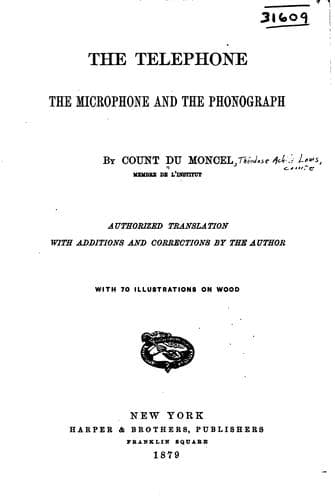
The telephone, the microphone & the phonographDu Moncel, Th., comte
History
The telephone, the microphone & the phonograph
Du Moncel, Th., comte
Microphone; Phonograph; Telephone
Mr. Fleeming Jenkin’s opinion only differs from mine in his ascribing
the energy of sound acquired by a telephone with an iron diaphragm to
the preponderance of sounds in the latter, whereas I consider it to
be chiefly due to the increase of energy in the whole magnetic system
produced by the reaction of the two magnetic parts on each other. If
the two effects could be taken singly, it is probable that the sounds
produced by each of them separately would be similar, since in magnetic
effects the reaction and action are equal. But as they are combined,
it becomes difficult to assign to each the share which belongs to
it in the general effect observed. Besides, it is quite possible
that the sounds of the diaphragm may appear to be stronger and more
distinct because it is nearer to the ear than the magnet, and because
the effects of magnetisation and demagnetisation are then more easily
produced in consequence of the mass of the magnetic body being smaller.
Mr. Fleeming Jenkin goes on to say that the question of the
displacement of surface in the diaphragm and magnet is very complex,
but that he thinks it impossible to deny the existence of such
displacement, since the air which acts as the vehicle of sound between
the ear and the source of sound is placed in vibration; yet this
displacement maybe effected quite otherwise than by flexion. Suppose
that the magnetic molecules of these bodies are drawn together by
magnetisation, which tends to diminish the intermolecular space which
separates them, the points of surface of the substance corresponding
to these intervals will be elevated in a manner equivalent to a
displacement of surface, and the effect of this will be the same as a
flexion movement. At the moment of demagnetisation a depression instead
of an elevation will take place, and the vibratory movements will
thus be produced without any electro-magnetic attraction, and it is
precisely these vibrations which Mr. Fleeming Jenkin terms molecular
vibrations. He evidently does not mean that such attractions cannot
take place: they may react, together with the molecular vibrations,
when the electric force is capable of producing them. He adds that the
reproduction of sounds by a condenser, by simple coils, and by a carbon
microphone, has convinced him that the action just analysed requires
generalisation.
Public-domain text, read in full here on John Shaqi.
Reviews
Reviews
No reviews yet
Be the first to share your thoughts on this work.
Elsewhere in the archive
Join the Discussion
Join the discussion
Sign in to leave a comment or review.
Sign InorCreate an account