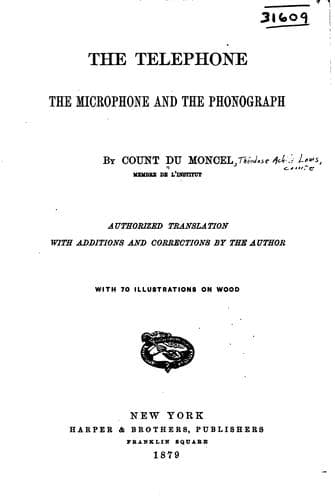
The telephone, the microphone & the phonographDu Moncel, Th., comte
History
The telephone, the microphone & the phonograph
Du Moncel, Th., comte
Microphone; Phonograph; Telephone
In this new system, which is only an improvement on Bell’s square
model, the horseshoe magnet is of a peculiar form, which renders it
more powerful. It is formed of a kind of half-circle of magnetised
steel, with its two ends turned back, so as to form a diameter of the
circle, only this diameter is divided in the centre: so that the two
poles of the magnet are placed one before the other, as in Faraday’s
electro-magnet. The poles are tipped with iron, terminating in front in
two thin iron plates, on which are placed the electro-magnetic coils,
which are oblong, and constitute the magnetic core. The diaphragm,
thicker than the ordinary diaphragms, is of tin, and is fixed firmly
to the edges of the circular box which encloses the whole, and which
forms a kind of sounding-box. The box is made of copper, and the
diaphragm is so firmly fastened to it as to become homogeneous with it,
and to give out a sound when the box is touched, which is not the case
in ordinary telephones. This is one of the conditions which make the
instrument a better conductor of sound. The magnet is also much more
powerful. It is magnetised by a current from a powerful Gramme machine,
which acts upon it for almost twenty minutes. The instrument has,
strictly speaking, no mouthpiece: the lid of the box which supports the
diaphragm, and is separated from it by a space of two millimètres, has
merely a hole bored in it above the centre of the diaphragm, and into
this hole either a tin trumpet, 50 centimètres in length, is screwed,
when the instrument is required to reproduce or transmit speech to a
distance, or an acoustic tube when it is to be used like an ordinary
telephone. The remarkable part of the system is that the instrument
can itself give a very loud call by only breathing into it instead of
speaking.
For this purpose a small oblong opening is made in the diaphragm at a
half diameter from its centre, and behind this the reed of an harmonium
is applied to a square copper plate fixed on the diaphragm itself. On
using the bellows the expelled air passes through this little hole,
and, on reaching the reed, sets it in vibration, and produces a sound
of which the acuteness depends on the conditions of the vibrating
plate. This addition to the diaphragm in no way alters its properties
in the reproduction of speech, so that, after using the bellows,
conversation may begin, and the receiving telephone repeats what is
said after emitting a sound somewhat resembling the note of a bugle.
The instrument is then provided with the speaking tube of which we
have spoken.
Public-domain text, read in full here on John Shaqi.
Reviews
Reviews
No reviews yet
Be the first to share your thoughts on this work.
Elsewhere in the archive
Join the Discussion
Join the discussion
Sign in to leave a comment or review.
Sign InorCreate an account