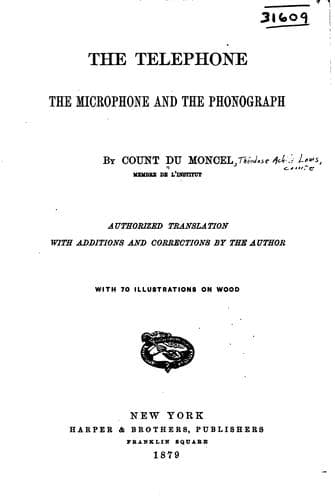
The telephone, the microphone & the phonographDu Moncel, Th., comte
History
The telephone, the microphone & the phonograph
Du Moncel, Th., comte
Microphone; Phonograph; Telephone
Nothing can be more remarkable than this power of listening to
conversation while seated in an armchair six or seven yards from
the instrument, nor is it necessary to move in order to reply. The
correspondent, indeed, must be close to the acoustic tube in order
to speak and listen, and he must speak rather loud in order to be
heard at any distance from the other station. But the listener
receives the sounds so amplified that it might be supposed that a
giant was speaking, and conversation held in a low tone may even be
distinguished. These results are really extraordinary, and even to
those familiar with such effects this incessant progress is surprising.
These results may be ascribed to the following causes:--
1. First, that the conditions of the magnet are better than those of
ordinary instruments.
2. That the diaphragm is also thicker, larger, and better stretched.
3. That the box is of metal, and calculated to act as a sounding-box.
4. The speaking trumpet magnifies the sounds.
5. The acoustic tubes concentrate the sound waves on the centre of the
diaphragm.
_Note on some fresh Experiments with Telephones without any Diaphragm._
In a paper published March 4, 1878, I made some suggestions on
the theory of the sounds produced in the telephone, and on the
contradictory assertions of physicists as to the transmission of speech
by ordinary telephones when devoid of diaphragm. These remarks induced
M. Ader to undertake some experiments which not only demonstrate the
truth of my opinion, but bring to light some fresh facts which may be
of great importance to acoustic science.
M. Ader has in fact not only succeeded in making a telephone without
a diaphragm speak, but he has made it speak more loudly and with less
alteration of the voice than we find to be the case with a small model
of the ordinary telephone. No one, therefore, can now maintain that the
sounds produced by the magnetic cores are so faint that they cannot be
taken into account among the effects produced, and that it is at any
rate impossible for them to reproduce articulate sounds.
To obtain this result, M. Ader reduced the size of the magnetic core to
that of a simple iron wire, one millimètre in diameter, and he fastened
it by one of its ends to a small wooden board. Under these conditions,
it was enough to fasten a small helix of fine wire on this iron wire,
and to apply the board to the ear in order to hear speech distinctly,
with the aid of a microphonic speaker actuated by a voltaic current.
But the range of sound was considerably increased if a mass of metal
was applied to the free end of the iron wire: in this case it was
possible to hear when the wooden board was removed to a distance of ten
or fifteen centimètres from the ear.
Public-domain text, read in full here on John Shaqi.
Reviews
Reviews
No reviews yet
Be the first to share your thoughts on this work.
Elsewhere in the archive
Join the Discussion
Join the discussion
Sign in to leave a comment or review.
Sign InorCreate an account