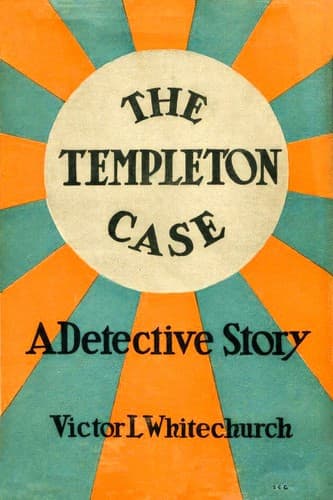
The Templeton caseWhitechurch, Victor L. (Victor Lorenzo)
General
The Templeton case
Whitechurch, Victor L. (Victor Lorenzo)
Detective and mystery stories; Murder -- Investigation -- Fiction; Police -- England -- Fiction
“_Possible suspects._ (1) Moss. Why did he leave in such a hurry? The
fact of the murderer being on the spot last night, when he got that
walking-stick, seems to rule Moss out. But not necessarily. He might
easily have run down from London last night. There’s a lot to be
inquired into here. (2) Grayson, the artist. Why did he leave in a
hurry? He’s certainly got to be run to earth. (3) Proctor. Yes—Proctor
puzzles me. Such a cool old chap! He would have known exactly where to
land in that canoe—and, if so, he knew perfectly well that the boy
would find it there in the morning. Also, he’s been in Switzerland.
That stick again! And I thought he was never going to leave off
examining that cigar band at the inquest. We must keep a sharp eye on
Proctor. If he’s not simply a fool, he’s as wily as they make ’em.”
When he had closed his notebook and put it in his pocket, the
detective lighted his pipe and sat, smoking thoughtfully, looking out
of the window. He realised that the case was all the more difficult
because the few clues that he held, and the slight facts he had to go
upon, might equally apply to any one of the three persons he had
enumerated as being suspicious. And if, as it seemed, his work was to
eliminate two of these persons, he was anxious to make no mistake.
Colson was not the detective of fiction. He was simply a shrewd,
careful man, keenly observant, with a police training. Had he been
that brilliant genius which the writer of fiction is so fond of
delineating, he would, after his manner, by this time have made some
supernaturally clever deduction, which would have enabled him to spot
the criminal at once, and to run him down unerringly, with the
additional triumph attached to it that all his colleagues, and every
other person concerned, had been absolutely wrong in their suspicions.
He would, probably, have adopted extraordinary disguises, kept all his
clues and methods to himself, and never have given a hint of them to
his superior officers, and finally have achieved that superlative
climax in which he would have exclaimed, “Alone I did it!”
But Colson was what, in spite of the writers of fiction, is a useful
personage in tracing crime—Colson was a policeman, and he knew the
value of those often-derided police methods. He, for example, could
sit now, calmly smoking his pipe, secure in the knowledge that every
police station in the district was on the look-out for Grayson, the
artist, that in a very short time Moss would probably be found—also by
police methods—and that a little police machinery, which the
superintendent was already putting in hand as a result of their brief
conference after the inquest, would prevent Proctor from slipping away
from the neighbourhood unobserved—if he had any such idea in his mind.
Public-domain text, read in full here on John Shaqi.
Reviews
Reviews
No reviews yet
Be the first to share your thoughts on this work.
Join the Discussion
Join the discussion
Sign in to leave a comment or review.
Sign InorCreate an account