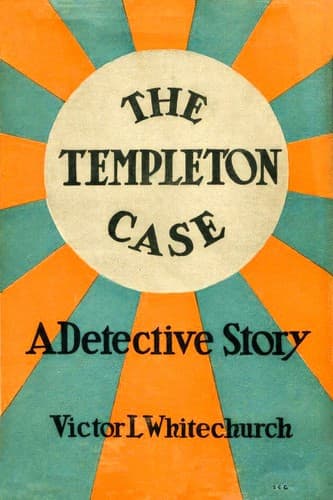
The Templeton caseWhitechurch, Victor L. (Victor Lorenzo)
General
The Templeton case
Whitechurch, Victor L. (Victor Lorenzo)
Detective and mystery stories; Murder -- Investigation -- Fiction; Police -- England -- Fiction
As Colson looked out of the window, half lost in reflections, he
noticed a man detach himself from the little group that still lingered
near the scene of the tragedy, and go walking up the quay, hands in
pockets. It was Tom Gale, the “crew and cook” of the schooner that was
still moored at the quay head, waiting for his cargo.
An idea struck the detective.
“That chap was about all the time,” he argued, “it might be worth
while having another chat with him.”
So he went out, strolled along the quay, and finally stepped aboard
the schooner, where he found Tom Gale in his favourite attitude of
leaning over the bulwarks.
“Well,” he said, as he went up to him, “you gave your evidence well
to-day, my man. We like a witness who speaks out plainly, and you did
it.”
Tom grinned approval of the compliment. Inwardly he was proud of being
in any way mixed up with the case. He knew he could tell the
story—with self-complimentary embellishments—for many weeks in divers
bars, and that many invitations to “have one with me, mate,” would be
the resulting homage.
“Ah,” he said, “I told ’em what I knew. I wish it had been more, sir.”
“So do we all. But what you told us of Templeton crossing the
estuary—and seeing Moss—was important, you know.”
Tom Gale made a mental note of how he could truthfully say afterwards
that if it hadn’t been for him the police would have missed the very
essence of things—the detective himself had told him so—and then
spoke.
“Ah,” he said, “I seen him plain enough. Just over yonder ’twas,” and
he jerked his thumb in the direction of the opposite shore, “that ’ere
little Jew fellow, Moss, he stood on the shore, just there. D’ye think
’twas him as did it, sir?” he asked with relish.
The detective shook his head mysteriously.
“Ah,” he said, “we mustn’t jump to conclusions hastily, you know. So
you saw him plainly, did you?”
“Ah. T’other chap was only just a-askin’ on me who lived in that house
and I was tellin’ on him, when there was Moss himself—I pointed ’im
out.”
“What do you mean by ‘t’other chap’?” asked the detective sharply.
“Why, him as was standin’ just where you might be, sir, at the
time—that young artist feller what was lodging at the ‘Mariner’s
Arms.’”
“Oh!” said Colson, thoughtfully, “he was with you, was he?”
“O’ course he was, sir—now, ought I to ha’ told ’em that at the
inquest? I never thought of it.”
“No, no,” said the other. “It didn’t matter at all. But, tell me. If
this artist—Grayson is his name—was with you, did he recognise Mr.
Templeton when he came back? Or speak to him?”
Tom Gale shook his head.
“No, sir; directly Mr. Templeton started coming across, this here
artist chap went straight back to the inn—looked almost as if he
didn’t want Mr. Templeton to see him.”
“Oh, did it?” said Colson. “Yes, I see.”
He filled his pipe and handed his pouch to the other man. Tom Gale put
his hand in his pocket, ostensibly to get his pipe, and exclaimed:
Public-domain text, read in full here on John Shaqi.
Reviews
Reviews
No reviews yet
Be the first to share your thoughts on this work.
Join the Discussion
Join the discussion
Sign in to leave a comment or review.
Sign InorCreate an account