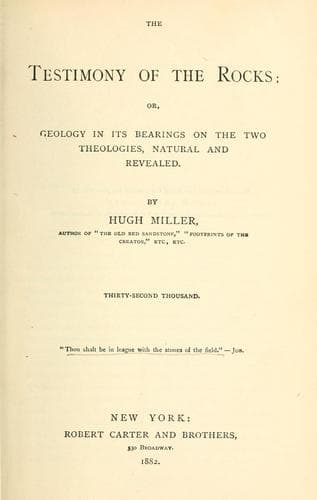
The Testimony of the Rocks: or, Geology in Its Bearings on the Two Theologies, Natural and RevealedMiller, Hugh
Philosophy
The Testimony of the Rocks: or, Geology in Its Bearings on the Two Theologies, Natural and Revealed
Miller, Hugh
Bible and geology; Creation; Religion and science
A further question still remains: _If_ the revelation was by vision,
that circumstance affords of itself a satisfactory reason why the
description should be _optical_; and, on the other hand, since the
description is decidedly _optical_, the presumption is of course strong
that the revelation was by vision. But why, it may be asked, by vision?
Can the presumption be yet further strengthened by showing that this
visual mode or form was preferable to any other? Can there be a reason,
in fine, assigned _for_ the _reason_,--for that revelation by vision
which accounts for the optical character of the description? The
question is a difficult one; but I think there can. There seems to be a
peculiar fitness in a revelation made by vision, for conveying an
account of creation to various tribes and peoples of various degrees of
acquirement, and throughout a long course of ages in which the knowledge
of the heavenly bodies or of the earth's history, that is, the sciences
of astronomy and geology, did not at first exist, but in which
ultimately they came to be studied and known. We must recognize such a
mode as equally fitted for the earlier and the more modern times,--for
the ages anterior to the rise of science, and the ages posterior to its
rise. The prophet, by describing what he had actually seen in language
fitted to the ideas of his time, would shock no previously existing
prejudice that had been founded on the apparent evidence of the senses;
he could as safely describe the moon as the second great light of
creation, as he could the sun as its first great light, and both, too,
as equally subordinate to the planet which we inhabit. On the other
hand, an enlightened age, when it had come to discover this key to the
description, would find it _optically_ true in all its details. But how
differently would not a revelation have fared, in at least the earlier
time, that was strictly scientific in its details,--a revelation, for
instance, of the great truth demonstrated by Galileo, that the sun rests
in the centre of the heavens, while the apparently immoveable earth
sweeps with giddy velocity around it; or of the great truth demonstrated
by Newton, that our ponderous planet is kept from falling off into empty
space by the operation of the same law that impels a descending pebble
towards the ground! A great miracle wrought in proof of the truth of the
revelation might serve to enforce the belief of it on the generation to
whom it had been given; but the generations that followed, to whom the
miracle would exist as a piece of mere testimony, would credit, in
preference, the apparently surer evidence of their senses, and become
unbelievers. They would act, all unwittingly, on the principle of Hume's
famous argument, and prefer to rest rather on their own _experience_ of
the great phenomena of nature, than on the doubtful testimony of their
ancestors, reduced in the lapse of ages to a dim, attenuated tradition.
Public-domain text, read in full here on John Shaqi.
Reviews
Reviews
No reviews yet
Be the first to share your thoughts on this work.
Elsewhere in the archive
Join the Discussion
Join the discussion
Sign in to leave a comment or review.
Sign InorCreate an account