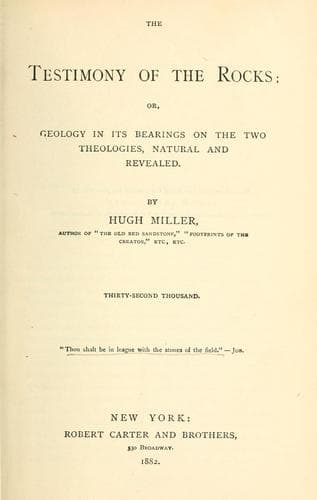
The Testimony of the Rocks: or, Geology in Its Bearings on the Two Theologies, Natural and RevealedMiller, Hugh
Philosophy
The Testimony of the Rocks: or, Geology in Its Bearings on the Two Theologies, Natural and Revealed
Miller, Hugh
Bible and geology; Creation; Religion and science
Nor would a geological revelation have fared better, in at least those
periods intermediate between the darker and more scientific ages, in
which ingenious men, somewhat skeptical in their leanings, cultivate
literature, and look down rather superciliously on the ignorance and
barbarism of the past. What would skeptics such as Hobbes and Hume have
said of an opening chapter in Genesis that would describe successive
periods,--first of molluscs, star-lilies, and crustaceans, next of
fishes, next of reptiles and birds, then of mammals, and finally of man;
and that would minutely portray a period in which there were lizards
bulkier than elephants, reptilian whales furnished with necks slim and
long as the bodies of great snakes, and flying dragons, whose spread of
wing greatly more than doubled that of the largest bird? The world would
assuredly not receive such a revelation. Nor, further, have scientific
facts or principles been revealed to man which he has been furnished
with the ability of observing or discovering for himself. It is
according to the economy of revelation, that the truths which it
exhibits should be of a kind which, lying beyond the reach of his ken,
he himself could never have elicited. From every view of the case, then,
a prophetic exhibition of the pre-Adamic scenes and events by vision
seems to be the one best suited for the opening chapters of a revelation
vouchsafed for the accomplishment of moral, not scientific purposes, and
at once destined to be contemporary with every stage of civilization,
and to address itself to minds of every various calibre, and every
different degree of enlightenment.
Public-domain text, read in full here on John Shaqi.
Reviews
Reviews
No reviews yet
Be the first to share your thoughts on this work.
Elsewhere in the archive
Join the Discussion
Join the discussion
Sign in to leave a comment or review.
Sign InorCreate an account