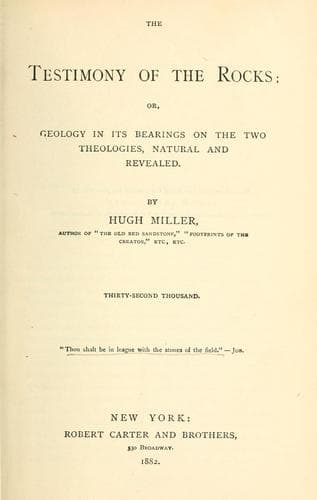
The Testimony of the Rocks: or, Geology in Its Bearings on the Two Theologies, Natural and RevealedMiller, Hugh
Philosophy
The Testimony of the Rocks: or, Geology in Its Bearings on the Two Theologies, Natural and Revealed
Miller, Hugh
Bible and geology; Creation; Religion and science
bare hot rocks, and tenantless, steam-emitting seas, of the previous
time. Under a gray, opaque sky, in which neither sun nor moon appear, we
are not unfrequently presented with a varied drapery of clouds,--a
drapery varied in form, though not in color: bank often seems piled over
bank, shaded beneath and lighter above; or the whole breaks into dappled
cloudlets, which bear--to borrow from the poetic description of
Bloomfield--the "beauteous semblance of a flock at rest." And if such
ærial draperies appeared in this early period, with the clear space
between them and the earth which we so often see in gray, sunless days,
the optical aspect must have been widely different from that of the
previous time, in which a dense vaporous fog lay heavy upon rock and
sea, and extended from the earth's surface to the upper heights of the
atmosphere.
The third day's vision seems to be more purely geological in its
character than either of the previous two. Extensive tracts of dry land
appear, and there springs up over them, at the Divine command, a rank
vegetation. And we know that what seems to be the corresponding
Carboniferous period, unlike any of the preceding ones, was remarkable
for its great tracts of terrestrial surface, and for its extraordinary
flora. For the first time dry land, and organized bodies at once bulky
enough, and exhibited in a medium clear enough, to render them
conspicuous objects in a distant prospect, appear in the Mosaic drama;
and we still find at once evidence of the existence of extensive though
apparently very flat lands, and the remains of a wonderfully gigantic
and abundant vegetation, in what appear to be the rocks of this period.
The vision of the fourth day, like that of the second, pertained not to
the earth, but to the _heavens_; the sun, moon, and stars become
visible, and form the sole subjects of the prophetic description. And
just as, during the second period, the earth would in all probability
have failed to furnish any feature of mark enough to divert a human eye
placed on a commanding station from the conspicuous _atmospheric_
phenomena of the time, so it seems equally probable that during this
fourth period it would have failed to furnish any feature of mark enough
to divert a human eye from the still more conspicuous _celestial_
phenomena of the time. As has been already incidentally remarked, the
Permian and Triassic periods were "epochs"--to employ the language of
the late Professor Edward Forbes--"of great poverty of production of
generic types." On the other hand, the appearance for the first time of
sun, moon, and stars, must have formed a scene well suited to divert the
attention of the seer from every other. Nor (as has been somewhat rashly
argued by Dr. Kitto and several others) does it seem irrational to hold
that three very extended _periods_ should have elapsed ere the sidereal
heavens became visible on earth. Addison's popular illustration, drawn
Public-domain text, read in full here on John Shaqi.
Reviews
Reviews
No reviews yet
Be the first to share your thoughts on this work.
Elsewhere in the archive
Join the Discussion
Join the discussion
Sign in to leave a comment or review.
Sign InorCreate an account