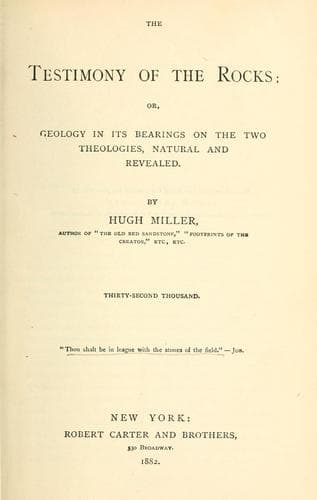
The Testimony of the Rocks: or, Geology in Its Bearings on the Two Theologies, Natural and RevealedMiller, Hugh
Philosophy
The Testimony of the Rocks: or, Geology in Its Bearings on the Two Theologies, Natural and Revealed
Miller, Hugh
Bible and geology; Creation; Religion and science
from one of the calculations of Newton, made in an age when comets were
believed to be solid bodies, rendered the reading public familiar,
considerably more than a century ago, with the vast time which large
bodies greatly heated would take in cooling. "According to Sir Isaac
Newton's calculation," said the exquisitely classical essayist, "the
comet that made its appearance in 1680 imbibed so much heat by its
approaches to the sun, that it would have been two thousand times hotter
than red hot iron had it been a globe of that metal; and that, supposing
it as big as the earth, and at the same distance from the sun, it would
be fifty thousand years in cooling before it recovered its natural
temper." Such was an estimate of the philosopher, that excited no little
wonder in the days of our great grandfathers, for the vast time which it
demanded; and, now that the data on which such a calculation ought to be
founded are better known than in the age of Newton, yet more time would
be required still. It is now ascertained, from the circumstance that no
dew is deposited in our summer evenings save under a clear sky, that
even a thin covering of cloud,--serving as a robe to keep the earth
warm,--prevents the surface heat of the planet from radiating into the
spaces beyond. And such a cloud, thick and continuous, as must have
wrapped round the earth as with a mantle during the earlier geologic
periods, must have served to retard for many ages the radiation, and
consequently the reduction, of that internal heat of which it was itself
a consequence. Further, the rocks and soils that form the surface of our
globe would be much more indifferent conductors of heat than the iron
superficies of Newton's ball, and would serve yet more to lengthen out
the cooling process. Nor would a planet covered over for ages with a
thick screen of vapor be a novelty even yet in the universe. It is
doubtful whether astronomers have ever yet looked on the face of
Mercury: it is at least very generally held that hitherto only his
clouds have been seen. Even Jupiter, though it is thought his mountains
have been occasionally detected raising their peaks through openings in
his cloudy atmosphere, is known chiefly by the dark shifting bands that,
streaking his surface in the line of his trade winds, belong not to his
body, but to his thick dark covering. It is questionable whether a human
eye on the surface of Mercury would ever behold the sun, notwithstanding
his near proximity; nor would he be often visible, if at all, from the
surface of Jupiter. Nor, yet further, would a warm steaming atmosphere
muffled in clouds have been unfavorable to a rank, flowerless vegetation
like that of the Coal Measures. There are moist, mild, cloudy days of
spring and early Summer that rejoice the heart of the farmer, for he
knows how conducive they are to the young growth on his fields. The Coal
Measure climate would have consisted of an unbroken series of these,
Public-domain text, read in full here on John Shaqi.
Reviews
Reviews
No reviews yet
Be the first to share your thoughts on this work.
Elsewhere in the archive
Join the Discussion
Join the discussion
Sign in to leave a comment or review.
Sign InorCreate an account