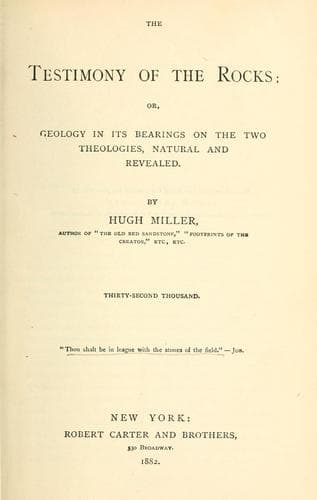
The Testimony of the Rocks: or, Geology in Its Bearings on the Two Theologies, Natural and RevealedMiller, Hugh
Philosophy
The Testimony of the Rocks: or, Geology in Its Bearings on the Two Theologies, Natural and Revealed
Miller, Hugh
Bible and geology; Creation; Religion and science
Let me briefly remark regarding this development hypothesis, with which
I have elsewhere dealt at considerable length, that while the facts of
the geologist are demonstrably such, that is, truths capable of proof,
the hypothesis is a mere dream, unsupported by a shadow of evidence. A
man of a lively imagination could no doubt originate many such dreams;
nay, we know that in the dark ages dreams of the kind were actually
originated. The _Anser Bernicla_, or barnacle goose, a common winter
visitant of our coasts, was once believed to be developed out of
decaying wood long submerged in sea water: and one of our commonest
cirripedes or barnacles, _Lepas anatifera_, still bears, in its specific
name of the goose-producing _lepas_, evidence that it was the creature
specially recognized by our ancestors as the half-developed goose. As if
in memory of this old development legend, the bird still bears the name
of the barnacle, and the barnacle of the bird; and we know further, that
very intelligent men for their age, such as Gerardes the herbalist
(1597), and Hector Boece the historian (1524), both examined these
shells, and, knowing but little of comparative anatomy, were satisfied
that the animal within was the partially developed embryo of a fowl.
Such was one of the fables gravely credited as a piece of natural
history in Britain about three centuries ago, and such was the kind of
evidence by which it was supported. And we know that the followers of
Epicurus received from their master, without apparent suspicion, fables
still more extravagant, and that wanted even such a shadow of proof to
support them as satisfied the herbalist and the historian. The
Epicureans at least professed to believe that the earth, after
spontaneously producing herbs and trees, began to produce in great
numbers mushroom-like bodies, that, when they came to maturity, burst
open, giving egress each to a young animal, which proved the founder of
a race; and that thus, in succession, all the members of the animal
kingdom were ushered into existence. But whether the dream be that of
the Epicureans of classic times, or that of the naturalists of the
middle ages, or that of the Lamarckians of our own days, it is equally a
dream, and can have no place assigned to it among either the solid facts
or the sober deductions of science. Nay, the dream of the Lamarckians
labors under a special disadvantage, from which the dreams of the others
are free. If some modern Boece or Epicurus were to assert that at
certain definite periods, removed from fifteen to fifty thousand years
from the present time, all our existing animals were developed from
decaying wood, or from a wonderful kind of mushrooms that the earth
produced only once every ten thousand years, the assertion, if incapable
of proof, would be at least equally incapable of being _dis_-proven. But
when the Lamarckian affirms that all our recent species of plants and
Public-domain text, read in full here on John Shaqi.
Reviews
Reviews
No reviews yet
Be the first to share your thoughts on this work.
Elsewhere in the archive
Join the Discussion
Join the discussion
Sign in to leave a comment or review.
Sign InorCreate an account