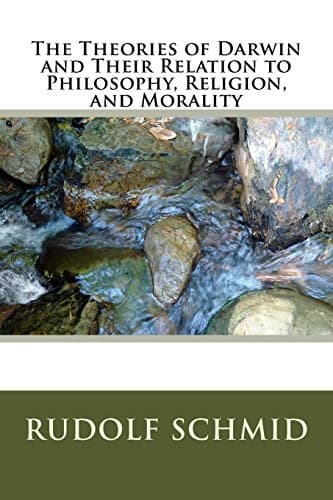
The Theories of Darwin and Their Relation to Philosophy, Religion, and MoralitySchmid, Rudolf
Religion
The Theories of Darwin and Their Relation to Philosophy, Religion, and Morality
Schmid, Rudolf
Evolution; Religion and science
individual names--was also done in the realm of the world's history: this,
Darwin did in the realm of the history of the organic kingdoms, seconded by
the geological principles of Sir Charles Lyell and by the investigations in
biology and comparative anatomy of a number of scientists. From this point
of view, the movement which was inaugurated by Darwin seems to us but the
reflex of the universal spirit of the present time upon a particular realm;
namely, that of natural science. But since, soon after the appearance of
the before-mentioned work and long before the publication of Darwin's
"Descent of Man," man also was included in the consequences of the
evolution theory, and his existence was explained as a wholly natural
development out of lower animal forms; since Darwin himself unreservedly
adopted this theory of the descent of man from the animal world as an
entirely natural consequence of his doctrine of the origin of species, the
evolution question has gone far beyond the proportionately narrow and
limited bounds of natural philosophy and of merely theoretical scientific
interest--has surpassed in interest all the before-mentioned
investigations, however lively this interest was and is to-day, and has
stirred up the minds of all most thoroughly, not only in their scientific
but also in their religious and ethical depths, some in {19} acknowledgment
and admiration, others in aversion and repugnance, and only a few in sober
and unprejudiced judgment. While some see in Darwinism the flambeau which
now lights mankind to entirely new paths of truth, and also to spiritual
and moral perfection, others see in it only an unproved hypothesis,
threatening to become the torch which might change the noblest and greatest
acquirements of the culture of past centuries into a heap of ashes; while
some date from it a new period of culture, others see in it a deep descent
of the present from the scientific, religious, and moral height which
mankind has ascended.
Public-domain text, read in full here on John Shaqi.
Reviews
Reviews
No reviews yet
Be the first to share your thoughts on this work.
Join the Discussion
Join the discussion
Sign in to leave a comment or review.
Sign InorCreate an account