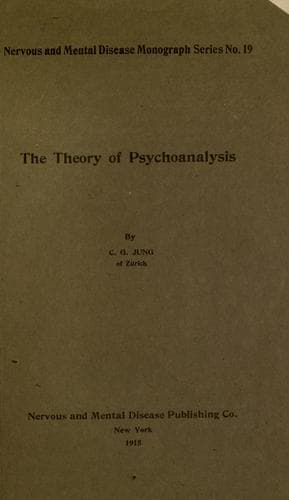
The Theory of PsychoanalysisJung, C. G. (Carl Gustav)
Science
The Theory of Psychoanalysis
Jung, C. G. (Carl Gustav)
Neuroses; Psychoanalysis; Psychology, Pathological; Sex
The change in the shock-theory already referred to, namely, that in
general the shock is not even real, but is essentially a phantasy, did
not make things better. On the contrary, still worse, since we are
forced to the conclusion that we find in the infantile phantasy at least
one positive sexual manifestation. It is no longer some brutal
accidental impression from the outside, but a positive sexual
manifestation created by the child itself, and this very often with
unmistakable clearness. Even real traumatic events of an outspoken
sexual type do not always happen to a child quite _without its
coöperation_, but are not infrequently apparently _prepared and brought
about by the child itself_. Abraham stated this, proving his statement
with evidence of the greatest interest, and this, in connection with
many other experiences of the same kind, makes it very probable that
even really sexual scenes are frequently called forth and supported by
the peculiar psychological state of the child’s mind. Perfectly
independently from psychoanalytic investigation, medical criminology has
discovered striking parallels to this psychoanalytic statement.
Footnote 1:
“Selected Papers on Hysteria and Other Psychoneuroses,” by Prof.
Sigmund Freud. Nervous and Mental Disease Monograph Series, No. 4.
Footnote 2:
Monograph No. 4, p. 14.
Footnote 3:
_Ibid._
CHAPTER II
The Infantile Sexuality
The precocious manifestations of sexual phantasy as cause of the shock
now seemed to be the source of neurosis. This, logically, attributed to
children a far more developed sexuality than had been hitherto admitted.
Many cases of precocious sexuality had been recorded in literature long
before the time of psychoanalysis. For instance, a girl of two years old
with normal menstruation, or cases of boys of three and four and five
years of age having normal erections, and so far ready for cohabitation.
These were, however, curiosities. Great astonishment was caused when
Freud began to attribute to the child, not only ordinary sexuality, but
even polymorphic perverse sexuality; all this based upon the most
exhaustive investigation. People inclined much too lightly to the
superficial view, that all this was merely suggested to the patients,
and was a highly disputable artificial product. Hence Freud’s[4] “Three
Contributions to the Sexual Theory” not only provoked opposition, but
even violent indignation. It is surely unnecessary to insist upon the
fact that science is not furthered by indignation, and that arguments of
moral resentment may perhaps please the moralist—that is his
business—but not a scientific man, for whom truth must be the guide, and
not moral indignation. If matters are really as Freud describes them,
all indignation is absurd; if they are not so, again indignation will
avail nothing. The conclusion as to what is the truth can only be
Public-domain text, read in full here on John Shaqi.
Reviews
Reviews
No reviews yet
Be the first to share your thoughts on this work.
Join the Discussion
Join the discussion
Sign in to leave a comment or review.
Sign InorCreate an account