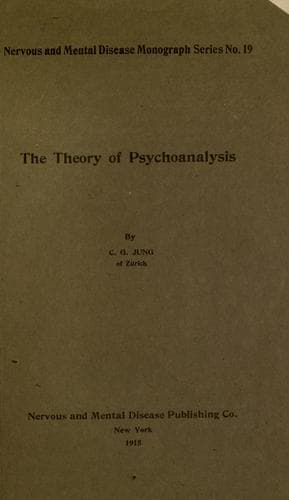
The Theory of PsychoanalysisJung, C. G. (Carl Gustav)
Science
The Theory of Psychoanalysis
Jung, C. G. (Carl Gustav)
Neuroses; Psychoanalysis; Psychology, Pathological; Sex
arrived at on the field of observation and research, and nowhere else.
The opponents of psychoanalysis with certain honorable exceptions,
display rather ludicrously a somewhat pitifully inadequate realization
of the situation. Although the psychoanalytic school could unfortunately
learn nothing from their critics, as the criticism took no notice of its
investigations, and although it could not get any useful hints, because
the psychoanalytic method of investigation was, and still is unknown to
these critics, it remains a serious duty for our school to explain
thoroughly the contrast between the existing conceptions. It is not our
endeavor to put forward a paradoxical theory contradicting all existing
theories, but rather to introduce a certain category of new observations
into science. Therefore we regard it as a duty to do whatever we can to
promote agreement. It is true, we must renounce all hope of obtaining
the approval of those who blindly oppose us, but we do hope to come to
an understanding with scientific men. This will be my endeavor now in
attempting to sketch the further intellectual development of the
psychoanalytic conception, so far as the so-called sexual theory of the
neuroses is concerned.
Objections to the Sexual Hypothesis
As I said, the finding of precocious sexual phantasies, which seemed the
source of the neurosis, forced Freud to the view of a highly developed
sexuality in infancy. As you know, the reality of this observation has
been contested by many, who maintain that crude error, that
narrow-minded delusion, misled Freud and his whole school, alike in
Europe and in America, so that the Freudians saw things that never
existed. They regarded them as people in the grip of an intellectual
epidemic. I have to admit that I possess no way of defending myself
against criticism of this kind. The only thing I can do is to refer to
my own work, asking thoughtful persons if they discover there any clear
indications of madness. Moreover, I must maintain that science has no
right to start with the idea that certain facts do not exist. At the
most one can say: “This seems very improbable—we want still more proofs
and more research.” This is also our reply to the objection: “It is
impossible to discover anything trustworthy by the psychoanalytic
method, as this method is practically absurd.” No one believed in
Galileo’s telescope, and Columbus discovered America on a false
hypothesis. The psychoanalytic method may be full of errors, but this
should not prevent its use. Many chronological and medical observations
have been made with inadequate instruments. We must regard the
objections to the method as pretexts until our opponents come to grip
with the facts. It is there a decision must be reached—not by wordy
warfare.
Public-domain text, read in full here on John Shaqi.
Reviews
Reviews
No reviews yet
Be the first to share your thoughts on this work.
Join the Discussion
Join the discussion
Sign in to leave a comment or review.
Sign InorCreate an account