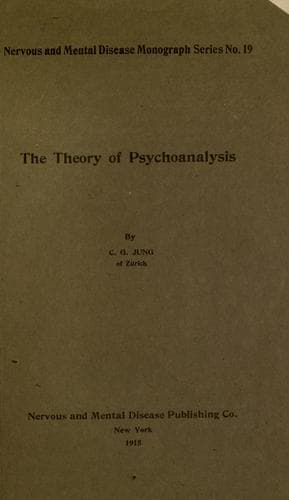
The Theory of PsychoanalysisJung, C. G. (Carl Gustav)
Science
The Theory of Psychoanalysis
Jung, C. G. (Carl Gustav)
Neuroses; Psychoanalysis; Psychology, Pathological; Sex
not justified, since the anatomical nomenclature is taken from the
fully-developed system, and special names are not generally given to
more or less rudimentary formations.
After all, the objections to the terminology do not spring so much from
objective arguments, as from those tendencies which lie at the base of
moral indignation. But then no objection can be made to the
sex-terminology of Freud, as he rightly gives to the whole sexual
development the general name of sexuality. But certain conclusions have
been drawn which, so far as I can see, cannot be maintained.
The “Sexuality” of the Suckling
When we examine how far back in childhood the first traces of sexuality
reach, we have to admit implicitly that sexuality already exists ab ovo,
but only becomes manifest a long time after intrauterine life. Freud is
inclined to see in the function of taking the mother’s breast already a
kind of sexuality. Freud was bitterly reproached for this view, but it
must be admitted that it is very ingenious, if we follow his hypothesis,
that the instinct of the preservation of the race has existed separately
from the instinct of self-preservation ab ovo and has undergone a
separate development. This way of thinking is not, however, a biological
one. It is not possible to separate the two ways of manifestation of the
hypothetical vital process, and to credit each with a different order of
development. If we limit ourselves to judging by what we can actually
observe, we must reckon with the fact that everywhere in nature we see
that the vital processes in an individual consist for a considerable
space of time in the functions of nutrition and growth only. We see this
very clearly in many animals; for instance, in butterflies, which as
caterpillars pass an asexual existence of nutrition and growth. To this
stage of life we may allot both the intrauterine life and the
extrauterine time of suckling in man. This time is marked by the absence
of all sexual function; hence to speak of manifest sexuality in the
suckling would be a contradictio in adjecto.
Public-domain text, read in full here on John Shaqi.
Reviews
Reviews
No reviews yet
Be the first to share your thoughts on this work.
Join the Discussion
Join the discussion
Sign in to leave a comment or review.
Sign InorCreate an account