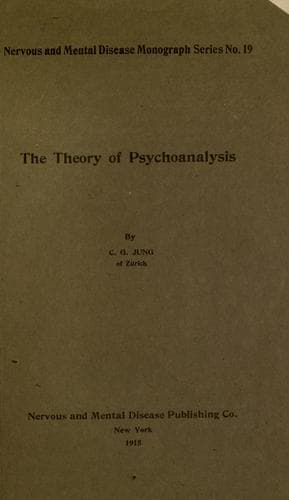
The Theory of PsychoanalysisJung, C. G. (Carl Gustav)
Science
The Theory of Psychoanalysis
Jung, C. G. (Carl Gustav)
Neuroses; Psychoanalysis; Psychology, Pathological; Sex
The first difficulty arises with the conception of sexuality. If we
take sexuality as meaning the fully-developed function, we must
confine this phenomenon to maturity, and then, of course, we have no
right to speak of sexuality in childhood. If we so limit our
conception, then we are confronted again with new and much greater
difficulties. The question arises, how then must we denominate all
those correlated biological phenomena pertaining to the sexual
functions sensu strictiori, as, for instance, pregnancy, childbirth,
natural selection, protection of the offspring, etc. It seems to me
that all this belongs to the conception of sexuality as well, although
a very distinguished colleague did once say, “Childbirth is not a
sexual act.” But if these things do pertain to this concept of
sexuality, then there must also belong innumerable psychological
phenomena. For we know that an incredible number of the pure
psychological functions are connected with this sphere. I shall only
mention the extraordinary importance of phantasy in the preparation
for the sexual function. Thus we arrive rather at a biological
conception of sexuality, which includes both a series of psychological
phenomena as well as a series of physiological functions. If we might
be allowed to make use of an old but practical classification, we
might identify sexuality with the so-called instinct of the
preservation of the species, as opposed in some way to the instinct of
self-preservation.
Looking at sexuality from this point of view, we shall not be astonished
to find that the root of the instinct of race-preservation, so
extraordinarily important in nature, goes much deeper than the limited
conception of sexuality would ever allow. Only the more or less grown-up
cat actually catches mice, but the kitten plays at least as if it were
catching mice. The young dog’s playful indications of attempts at
cohabitation begin long before puberty. We have a right to suppose that
mankind is no exception to this rule, although we do not notice similar
things on the surface in our well brought-up children. Investigation of
the children of the lower classes proves that they are no exceptions to
the biological rule. It is of course infinitely more probable that this
most important instinct, that of the preservation of the race, is
already nascent in the earliest childhood, than that it falls at one
swoop from heaven, full-fledged, at the age of puberty. The sexual
organs also develop long before the slightest sign of their future
function can be noticed. Where the psychoanalytic school speaks of
sexuality, this wider conception of its function must be linked to it,
and we do not mean simply that physical sensation and function generally
designated by the term sexual. It might be said that, in order to avoid
any misunderstanding on this point, the term sexuality should not be
given to these preparatory phenomena in childhood. This demand is surely
Public-domain text, read in full here on John Shaqi.
Reviews
Reviews
No reviews yet
Be the first to share your thoughts on this work.
Join the Discussion
Join the discussion
Sign in to leave a comment or review.
Sign InorCreate an account