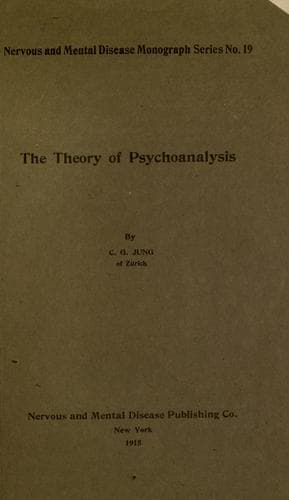
The Theory of PsychoanalysisJung, C. G. (Carl Gustav)
Science
The Theory of Psychoanalysis
Jung, C. G. (Carl Gustav)
Neuroses; Psychoanalysis; Psychology, Pathological; Sex
I must point out here that the analogy with the law of the conservation
of energy is very close. In both cases the question arises when an
effect of energy disappears, where is this energy meanwhile, and where
will it reemerge? Applying this point of view as a heuristic principle
to the psychology of human conduct, we shall make some astonishing
discoveries. Then we shall see how the most heterogeneous phases of
individual psychological development are connected in an energic
relationship. Every time we see a person who is splenetic or has a
morbid conviction, or some exaggerated mental attitude, we know here is
too much libido, and the excess must have been taken away from somewhere
else where there is too little. From this standpoint, psychoanalysis is
that method which discovers those places or functions where there is too
little or too much libido, and restores the just proportions. Thus the
symptoms of a neurosis must be considered as exaggerated and
correspondingly disturbed functional manifestations overflowing with
libido. The energy which has been used for this purpose has been taken
away from somewhere else, and it is the task of the psychoanalyst, to
restore it whence it was taken, or to bestow it where it was never
before given. Those complexes of symptoms which are mainly characterized
by lack of libido, for instance, the so-called apathetic conditions,
force us to reverse the question. Here we have to ask, where did the
libido go? The patient gives us the impression of having no libido, and
there are occasionally physicians who believe exactly what the patients
tell them. Such physicians have a primitive way of thinking, like the
savage who believes, when he sees an eclipse of the sun, that the sun
has been swallowed up and put to death. But the sun is only hidden, and
so it is with these patients. Although the libido is there, it is not
get-at-able, and is inaccessible to the patient himself. Superficially,
we have here a lack of libido. It is the task of psychoanalysis to
search for that hidden place where the libido dwells, and where it is as
a rule inaccessible to the patient. The hidden place is the
non-conscious, which may also be called the unconscious, without
ascribing to it any mysterious significance.
The Conception of Unconscious Phantasy
Public-domain text, read in full here on John Shaqi.
Reviews
Reviews
No reviews yet
Be the first to share your thoughts on this work.
Join the Discussion
Join the discussion
Sign in to leave a comment or review.
Sign InorCreate an account