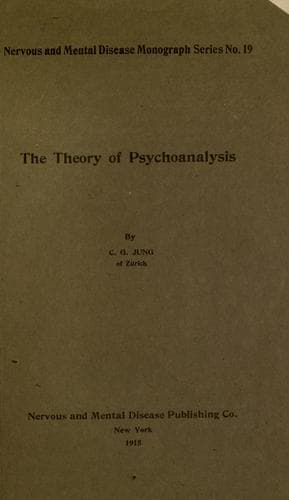
The Theory of PsychoanalysisJung, C. G. (Carl Gustav)
Science
The Theory of Psychoanalysis
Jung, C. G. (Carl Gustav)
Neuroses; Psychoanalysis; Psychology, Pathological; Sex
Psychoanalytic experience has taught us that there are non-conscious
systems which, by analogy with conscious phantasies, can be described as
phantasy-systems of the unconscious. In cases of neurotic apathy these
phantasy systems of the unconscious are the objects of the libido. We
know well that, when we speak of unconscious phantasy systems, we only
speak figuratively. We do not mean more by this than that we accept as
an indispensable postulate the conception of psychic entities existing
outside consciousness. Experience teaches us, we might say daily, that
there are unconscious psychic processes which influence the disposition
of the libido in a perceptible way. Those cases, known to every
psychiatrist in which complicated symptoms of delusions emerge with
relative great suddenness, show clearly that there must be unconscious
psychic development and preparation, for we cannot regard them as having
been just suddenly formed when they entered consciousness.
The Sexual Terminology
I feel myself justified in making this digression concerning the
unconscious. I have done it to point out that, with regard to shifting
of the manifestations of the libido, we have to deal not only with the
conscious, but also with another factor, the unconscious, whither the
libido sometimes disappears. We have not yet followed up the discussion
of the further consequences which result from the adoption of the
libido-theory.
Freud has taught us, and we see it in the daily practice of
psychoanalysis, that in earlier childhood, instead of the normal later
sexuality, we find many tendencies which in later life are called
perversions. We have to admit that Freud has the right to give to these
tendencies a sexual terminology. Through the introduction of the
conception of the libido, we see that in adults those elementary
components which seemed to be the origin and the source of normal
sexuality, lose their importance, and are reduced to mere
potentialities. The effective power, their life force, is to be found in
the libido. Without libido these components mean nothing. We saw that
Freud gives to the conception of libido an undoubted sexual definition,
somewhat in the sense of sexual desire. The general view is, that libido
in this sense only comes into being at the age of puberty. How are we
then to explain the fact that in Freud’s view a child has a
polymorphic-perverse sexuality, and that therefore, in children, the
libido brings into action not only one, but several possibilities? If
the libido, in Freud’s sense, begins its existence at puberty, it could
not be held accountable for earlier infantile perversions. In that case,
we should have to regard these infantile perversions as “faculties of
the mind,” in the sense of the theory of components. Apart from the
hopeless theoretical confusion which would thus arise, we must not
multiply explanatory principles in accordance with the philosophical
Public-domain text, read in full here on John Shaqi.
Reviews
Reviews
No reviews yet
Be the first to share your thoughts on this work.
Join the Discussion
Join the discussion
Sign in to leave a comment or review.
Sign InorCreate an account