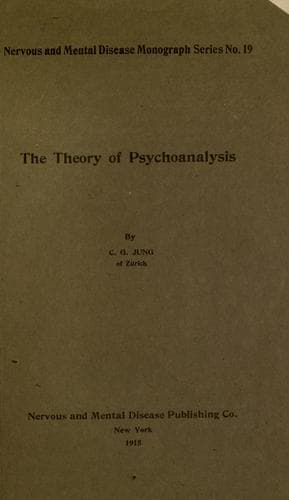
The Theory of PsychoanalysisJung, C. G. (Carl Gustav)
Science
The Theory of Psychoanalysis
Jung, C. G. (Carl Gustav)
Neuroses; Psychoanalysis; Psychology, Pathological; Sex
The intensity of the libido is said to be diminished relatively to the
early age. But we advanced just now several considerations to show why
it seems doubtful if we can regard the vital functions of a child,
sexuality excepted, as of less intensity than those of adults. We can
really say that, sexuality excepted, the emotional phenomena, and, if
nervous symptoms are present, then these likewise are quite as intense
as those of adults. On the energic conception of the libido all these
things are but manifestations of the libido. But it becomes rather
difficult to conceive that the intensity of the libido can ever
constitute the difference between a mature and an immature sexuality.
The explanation of this difference seems rather to postulate a change in
the localization of the libido (if the expression be allowed). In
contradistinction to the medical definition the libido in children is
occupied far more with certain side-functions of a mental and
physiological nature than with local sexual functions. One is here
already tempted to remove from the term libido the predicate “sexualis,”
and thus to have done with the sexual definition of the term given in
Freud’s “Three Contributions.” This necessity becomes imperative, when
we put it in the form of a question: The child in the first years of its
life is intensely living—suffering and enjoying—the question is, whether
his striving, his suffering, his enjoyment are by reason of his libido
sexualis? Freud has pronounced himself in favor of this supposition.
There is no need to repeat the reasons through which I am compelled to
accept the pre-sexual stage. The larva stage possesses a libido of
nutrition, if I may so express it, but not yet the libido sexualis. It
is thus we must put it, if we wish to keep the energic conception which
the libido theory offers us. I think there is nothing for it but to
abandon the sexual definition of libido, or we shall lose what there is
valuable in the libido theory, that is, the energic conception. For a
long time past the desire to extend the meaning of libido, and to remove
it from its narrow and sexual limitations, has forced itself upon
Freud’s school. One was never weary of insisting that sexuality in the
psychological sense was not to be taken too literally, but in a broader
connotation; but exactly how, that remained obscure, and thus too,
sincere criticism remained unsatisfied.
Public-domain text, read in full here on John Shaqi.
Reviews
Reviews
No reviews yet
Be the first to share your thoughts on this work.
Join the Discussion
Join the discussion
Sign in to leave a comment or review.
Sign InorCreate an account