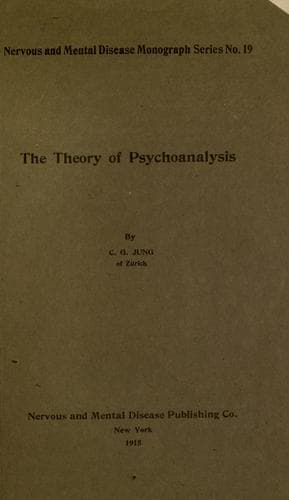
The Theory of PsychoanalysisJung, C. G. (Carl Gustav)
Science
The Theory of Psychoanalysis
Jung, C. G. (Carl Gustav)
Neuroses; Psychoanalysis; Psychology, Pathological; Sex
I do not think I am going astray if I see the real value of the libido
theory in the energic conception, and not in its sexual definition.
Thanks to the former, we are in possession of a most valuable heuristic
principle. We owe to the energic conception the possibility of dynamic
ideas and relationships, which are of inestimable value for us in the
chaos of the psychic world. The Freudians would be wrong not to listen
to the voice of criticism, which reproaches our conception of libido
with mysticism and inaccessibility. We deceived ourselves in believing
that we could ever make the libido sexualis the bearer of the energic
conception of the psychical life, and if many of Freud’s school still
believe they possess a well-defined and almost complete conception of
libido, they are not aware that this conception has been put to use far
beyond the bounds of its sexual definition. The critics are right when
they object to our theory of libido as explaining things which cannot
belong to its sphere. It must be admitted that Freud’s school makes use
of a conception of libido which passes beyond the bounds of its primary
definition. Indeed, this must produce the impression that one is working
with a mystical principle.
The Problem of Libido in Dementia Præcox
I have sought to show these infringements in a special work, “Wandlungen
und Symbole der Libido,” and at the same time the necessity for creating
a new conception of libido, which shall be in harmony with the energic
conception. Freud himself was forced to a discussion of his original
conception of libido when he tried to apply its energic point of view to
a well-known case of dementia præcox—the so-called Schreber case. In
this case, we had to deal, among other things, with that well-known
problem in the psychology of dementia præcox, the loss of adaptation to
reality, the peculiar phenomenon consisting in a special tendency of
these patients to construct an inner world of phantasy of their own,
surrendering for this purpose their adaptation to reality. As a part of
the phenomenon, the lack of sociability or emotional rapport will be
well known to you all, this representing a striking disturbance of the
function of reality. Through considerable psychological study of these
patients we discovered, that this lack of adaptation to reality is
compensated by a progressive increase in the creation of phantasies.
This goes so far that the dream-world is for the patient more real than
external reality. The patient Schreber, described by Freud, found for
this phenomenon an excellent figurative description in his delusion of
the “end of the world.” His loss of reality is thus very concretely
represented. The dynamic conception of this phenomenon is very clear. We
say that the libido withdrew itself more and more from the external
world, consequently entered the inner world, the world of phantasies,
and had there to create, as a compensation for the lost external world,
Public-domain text, read in full here on John Shaqi.
Reviews
Reviews
No reviews yet
Be the first to share your thoughts on this work.
Join the Discussion
Join the discussion
Sign in to leave a comment or review.
Sign InorCreate an account