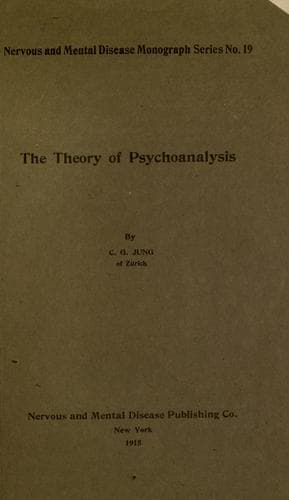
The Theory of PsychoanalysisJung, C. G. (Carl Gustav)
Science
The Theory of Psychoanalysis
Jung, C. G. (Carl Gustav)
Neuroses; Psychoanalysis; Psychology, Pathological; Sex
If this were so, the withdrawal of erotic interests in
the neuroses would lead to a loss of reality—a loss of reality indeed
that could be compared with that in dementia præcox. But, as I said
before, this is not the case. These facts have made it impossible for me
to transfer Freud’s libido theory to dementia præcox. Hence, my view is,
that the attempt made by Abraham, in his article “The Psycho-Sexual
Differences Between Hysteria and Dementia Præcox,” is from the
standpoint of Freud’s conception of libido theoretically untenable.
Abraham’s belief, that the paranoidal system, or the symptomatology of
dementia præcox, arises by the libido withdrawing from the external
world, cannot be justified if we take “libido” according to Freud’s
definition. For, as Freud has clearly shown, a mere introversion or
regression of the libido leads always to a neurosis, and not to dementia
præcox. It is impossible to transfer the libido theory, with its sexual
definition, directly to dementia præcox, as this disease shows a loss of
reality not to be explained by the deficiency in erotic interests.
It gives me particular satisfaction that our master also, when he placed
his hand on the fragile material of paranoiac psychology, felt himself
compelled to doubt the applicability of his conception of libido which
had prevailed hitherto. My position of reserve towards the ubiquity of
sexuality which I allowed myself to adopt in the preface to my
“Psychology of Dementia Præcox”—although with a complete recognition of
the psychological mechanism—was dictated by the conception of the libido
theory of that time. Its sexual definition did not enable me to explain
those disturbances of functions which affect the indefinite sphere of
the instinct of hunger, just as much as they do those of sexuality. For
a long time the libido theory seemed to me inapplicable to dementia
præcox.
The Genetic Conception of Libido
With greater experience in my analytical work, I noticed that a slow
change of my conception of libido had taken place. A genetic conception
of libido gradually took the place of the descriptive definition of
libido contained in Freud’s “Three Contributions.” Thus it became
possible for me to replace, by the expression “psychic energy,” the term
libido. The next step was that I asked myself if now-a-days the function
of reality consists only to a very small extent of sexual libido, and to
a very large extent of other impulses. It is still a very important
question, considered from the phylogenetic standpoint, whether the
function of reality is not, at least very largely, of sexual origin. It
is impossible to answer this question directly, in so far as the
function of reality is concerned. We shall try to come to some
understanding by a side-path.
Public-domain text, read in full here on John Shaqi.
Reviews
Reviews
No reviews yet
Be the first to share your thoughts on this work.
Join the Discussion
Join the discussion
Sign in to leave a comment or review.
Sign InorCreate an account