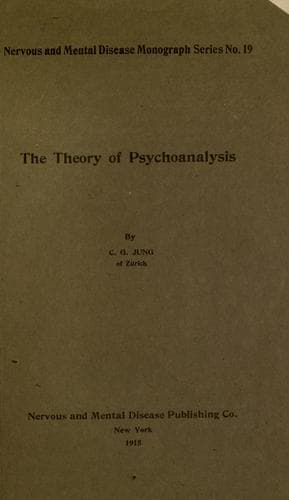
The Theory of PsychoanalysisJung, C. G. (Carl Gustav)
Science
The Theory of Psychoanalysis
Jung, C. G. (Carl Gustav)
Neuroses; Psychoanalysis; Psychology, Pathological; Sex
A superficial glance at the history of evolution suffices to teach us
that innumerable complicated functions, whose sexual character must be
denied, are originally nothing but derivations from the instinct of
propagation. As is well known, there has been an important displacement
in the fundamentals of propagation during the ascent through the animal
scale. The offspring has been reduced in number, and the primitive
uncertainty of impregnation has been replaced by a quite assured
impregnation, and a more effective protection of offspring. The energy
required for the production of eggs and sperma has been transferred into
the creation of mechanisms of attraction, and mechanisms for the
protection of offspring. Here we find the first instincts of art in
animals, used for the instinct of propagation, and limited to the
rutting season. The original sexual character of these biological
institutions became lost with their organic fixation, and their
functional independence. None the less, there can be no doubt as to
their sexual origin, as, for instance, there is no doubt about the
original relation between sexuality and music, but it would be a
generalization as futile, as unesthetic, to include music under the
category of sexuality. Such a terminology would lead to the
consideration of the Cathedral of Cologne under mineralogy, because it
has been built with stones. Those quite ignorant of the problems of
evolution are much astonished to find how few things there are in human
life which cannot finally be reduced to the instinct of propagation. It
embraces nearly everything, I think, that is dear and precious to us.
We have hitherto spoken of the libido as of the instinct of
reproduction, or the instinct of the preservation of the species, and
limited our conception to that libido which is opposed to hunger, just
as the instinct of the preservation of the species is opposed to that of
self-preservation. Of course in nature this artificial distinction does
not exist. Here we find only a continuous instinct of life, a will to
live, which tries to obtain the propagation of the whole race by the
preservation of the individual. To this extent this conception coincides
with that of Schopenhauer’s “will,” as objectively we can only conceive
a movement as a manifestation of an internal desire. As we have already
boldly concluded that the libido, which originally subserved the
creation of eggs and seed, is now firmly organized in the function of
nest-building, and can no longer be employed otherwise, we are similarly
obliged to include in this conception every desire, hunger no less. We
have no warrant whatever for differentiating essentially the desire to
build nests from the desire to eat.
Public-domain text, read in full here on John Shaqi.
Reviews
Reviews
No reviews yet
Be the first to share your thoughts on this work.
Join the Discussion
Join the discussion
Sign in to leave a comment or review.
Sign InorCreate an account