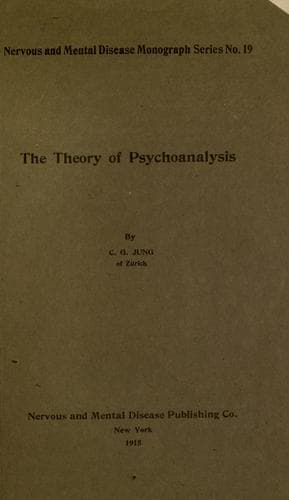
The Theory of PsychoanalysisJung, C. G. (Carl Gustav)
Science
The Theory of Psychoanalysis
Jung, C. G. (Carl Gustav)
Neuroses; Psychoanalysis; Psychology, Pathological; Sex
I think you will already understand the position we have reached with
these considerations. We are about to follow up the energic conception
by putting the energic mode of action in place of the purely formal
functioning. Just as reciprocal actions, well known in the old natural
science, have been replaced by the law of the conservation of energy, so
here too, in the sphere of psychology, we seek to replace the reciprocal
activities of coordinated psychical faculties by energy, conceived as
one and homogeneous. Thus we must bow to the criticism which reproaches
the psychoanalytic school for working with a mystical conception of
libido. I have to dispel this illusion that the whole psychoanalytic
school possesses a clearly conceived and obvious conception of libido. I
maintain that the conception of libido with which we are working is not
only not concrete or known, but is an unknown _X_, a conceptual image, a
token, and no more real than the energy in the conceptual world of the
physicist. In this wise only can we escape those arbitrary
transgressions of the proper boundaries, which are always made when we
want to reduce coördinated forces to one another. Certain analogies of
the action of heat with the action of light are not to be explained by
saying that this tertium comparationis proves that the undulations of
heat are the same as the undulations of light; the conceptual image of
energy is the real point of comparison. If we regard libido in this way
we endeavor to simulate the progress which has already been made in
physics. The economy of thought which physics has already obtained we
strive after in our libido theory. We conceive libido now simply as
energy, so that we are in the position to figure the manifold processes
as forms of energy. Thus, we replace the old reciprocal action by
relations of absolute equivalence. We shall not be astonished if we are
met with the cry of vitalism. But we are as far removed from any belief
in a specific vital power, as from any other metaphysical assertion. We
term libido that energy which manifests itself by vital processes, which
is subjectively perceived as aspiration, longing and striving. We see in
the diversity of natural phenomena the desire, the libido, in the most
diverse applications and forms. In early childhood we find libido at
first wholly in the form of the instinct of nutrition, providing for the
development of the body. As the body develops, there open up,
successively, new spheres of influence for the libido. The last, and,
from its functional significance, most overpowering sphere of influence,
is sexuality, which at first seems very closely connected with the
function of nutrition. With that you may compare the well-known
influence on propagation of the conditions of nutrition in the lower
animals and plants.
Public-domain text, read in full here on John Shaqi.
Reviews
Reviews
No reviews yet
Be the first to share your thoughts on this work.
Join the Discussion
Join the discussion
Sign in to leave a comment or review.
Sign InorCreate an account