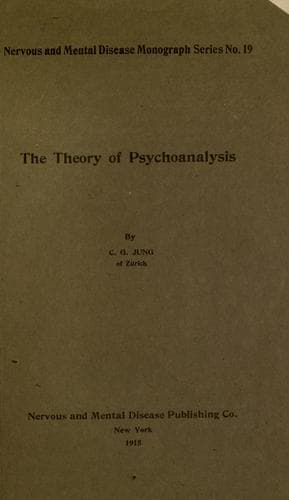
The Theory of PsychoanalysisJung, C. G. (Carl Gustav)
Science
The Theory of Psychoanalysis
Jung, C. G. (Carl Gustav)
Neuroses; Psychoanalysis; Psychology, Pathological; Sex
On the axiom: Principia præter necessitatem non sunt multiplicanda, this
kind of ideation is the only possible one. Hence we speak about the
effects of the unconscious, just as we do about the phenomena of the
conscious. Many people have been shocked by Freud’s statement: “The
unconscious can only wish,” and this is regarded as an unheard of
metaphysical assertion, something like the principle of Hartman’s
“Philosophy of the Unconscious,” which apparently administers a rebuff
to the theory of cognition. This indignation only arises from the fact
that the critics, unknown to themselves, evidently start from a
metaphysical conception of the unconscious as being an “end per se,” and
naïvely project on to us their inadequate conception of the unconscious.
For us, the unconscious is no entity, but a term, about whose
metaphysical entity we do not permit ourselves to form any idea. Here we
contrast with those psychologists, who, sitting at their desks, are as
exactly informed about the localization of the mind in the brain as they
are informed about the psychological correlation of the mental
processes. Whence they are able to declare positively that beyond the
consciousness there are but physiological processes of the cortex. Such
naiveté must not be imputed to the psychoanalyst. When Freud says: “We
can only wish,” he describes in symbolic terms effects of which the
origin is not known. From the standpoint of our conscious thinking,
these effects can only be considered as analogous to wishes. The
psychoanalytic school is, moreover, aware that the discussion as to
whether “wishing” is a sound analogy can be re-opened at any time.
Anyone who has more information is welcome. Instead, the opponents
content themselves with denial of the phenomena, or if certain phenomena
are admitted, they abstain from all theoretical speculation. This last
point is readily to be understood, for it is not everyone’s business to
think theoretically. Even the man who has succeeded in freeing himself
from the dogma of the identity of the conscious self and the psyche,
thus admitting the possible existence of psychic processes outside the
conscious, is not justified in disputing or maintaining psychic
possibilities in the unconscious. The objection is raised that the
psychoanalytic school maintains certain views without sufficient
grounds, as if the literature did not contain abundant, perhaps too
abundant, discussion of cases, and more than enough arguments. But they
seem not to be sufficient for the opponents. There must be a good deal
of difference as to the meaning of the term “sufficient” in respect to
the validity of the arguments. The question is: “Why does the
psychoanalytic school apparently set less store on the proof of their
formulas than the critics?” The reason is very simple. An engineer who
has built a bridge, and has worked out its bearing capacity, wants no
other proof for the success of its bearing power. But the ordinary man,
Public-domain text, read in full here on John Shaqi.
Reviews
Reviews
No reviews yet
Be the first to share your thoughts on this work.
Join the Discussion
Join the discussion
Sign in to leave a comment or review.
Sign InorCreate an account