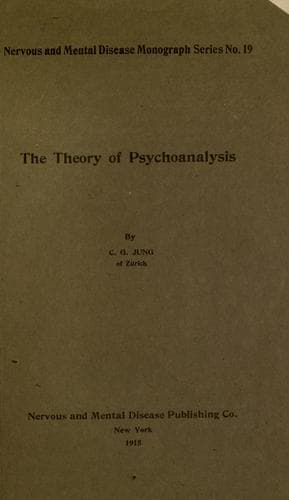
The Theory of PsychoanalysisJung, C. G. (Carl Gustav)
Science
The Theory of Psychoanalysis
Jung, C. G. (Carl Gustav)
Neuroses; Psychoanalysis; Psychology, Pathological; Sex
Without wishing to enter fully into the question of technique, I must
here meet an objection that is constantly heard. It is that the
so-called unconscious phantasies are only suggested to the patient and
only exist in the minds of psychoanalysts. This objection belongs to
that common class which ascribes to them the crude mistakes of
beginners. I think only those without psychological experience and
without historical psychological knowledge are capable of making such
criticisms. With a mere glimmering of mythological knowledge, one cannot
fail to notice the striking parallels between the unconscious phantasies
discovered by the psychoanalytic school and mythological images. The
objection that our knowledge of mythology has been suggested to the
patient is groundless, for the psychoanalytic school first discovered
the unconscious phantasies, and only then became acquainted with
mythology. Mythology itself is obviously something outside the path of
the medical man. In so far as these phantasies are unconscious, the
patient of course knows nothing about their existence, and it would be
absurd to make direct inquiries about them. Nevertheless it is often
said, both by patients and by so-called normal persons: “But if I had
such phantasies, surely I would know something about them.” But what is
unconscious is, in fact, something which one does not know. The
opposition too is perfectly convinced that such things as unconscious
phantasies could not exist. This a priori judgment is scholasticism, and
has no sensible grounds. We cannot possibly rest on the dogma that
consciousness only is mind, when we can convince ourselves daily that
our consciousness is only the stage. When the contents of our
consciousness appear they are already in a highly complex form; the
grouping of our thoughts from the elements supplied by our memory is
almost entirely unconscious. Therefore we are obliged, whether we like
it or not, to accept for the moment the conception of an unconscious
psychic sphere, even if only as a mere negative, border-conception, just
as Kant’s “thing in itself.” As we perceive things which do not have
their origin in consciousness, we are obliged to give hypothetic
contents to the sphere of the non-conscious. We must suppose that the
origin of certain effects lies in the unconscious, just because they are
not conscious. The reproach of mysticism can scarcely be made against
this conception of the unconscious. We do not pretend that we know
anything positive, or can affirm anything, about the psychic condition
of the unconscious. Instead, we have substituted symbols by following
the way of designation and abstraction we apply in consciousness.
Public-domain text, read in full here on John Shaqi.
Reviews
Reviews
No reviews yet
Be the first to share your thoughts on this work.
Join the Discussion
Join the discussion
Sign in to leave a comment or review.
Sign InorCreate an account