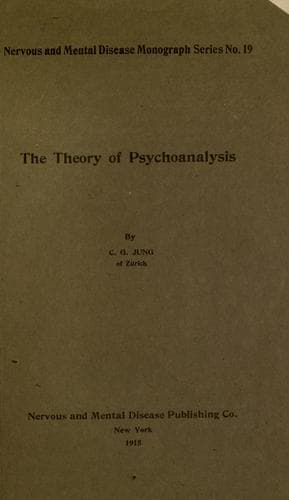
The Theory of PsychoanalysisJung, C. G. (Carl Gustav)
Science
The Theory of Psychoanalysis
Jung, C. G. (Carl Gustav)
Neuroses; Psychoanalysis; Psychology, Pathological; Sex
psychoanalysis, however, is not found here, as psychoanalysis is only
empirical. Here you find but a large and insufficiently cultivated
field, in which the critics can exercise themselves to their full
satisfaction. There are many uncertainties, and as many contradictions,
in the sphere of this theory. We were conscious of this long before the
first critic began to pay attention to our work.
CHAPTER VI
The Dream
After this digression we will return to the question of the unconscious
phantasies which occupied us before. As we have seen, nobody can dispute
their existence, just as nobody can assert their existence and their
qualities forthwith. The question, however, is just this: Can effects be
observed in the consciousness of unconscious origin, which can be
described in conscious symbolic signs or expressions? Can there be
found, in the conscious, effects which correspond with this expectation?
The psychoanalytic school believes it has discovered such effects. Let
me mention at once the principal phenomenon, the dream. Of this it may
be said that it appears in the consciousness as a complex factor
unconsciously constructed out of its elements. The origin of the images
in certain reminiscences of the earlier or of the later past can be
proved through the associations belonging to the single images of the
dream. We ask: “Where did you see this?” or “Where did you hear that?”
And through the usual way of association come the reminiscences that
certain parts of the dream have been consciously experienced, some the
day before, some on former occasions. So far there will be general
agreement, for these things are well known. In so far, the dream
represents in general an incomprehensible composition of certain
elements not at first conscious, which are only recognized later on by
their associations. It is not that all parts of the dream are
recognizable, whence its conscious character could be deduced; on the
contrary, they are often, and indeed mostly, unrecognizable at first.
Only subsequently does it occur to us that we have experienced in
consciousness this or that part of the dream. From this standpoint
alone, we might regard the dream as an effect of unconscious origin.
The Method of Dream Analysis
Public-domain text, read in full here on John Shaqi.
Reviews
Reviews
No reviews yet
Be the first to share your thoughts on this work.
Join the Discussion
Join the discussion
Sign in to leave a comment or review.
Sign InorCreate an account