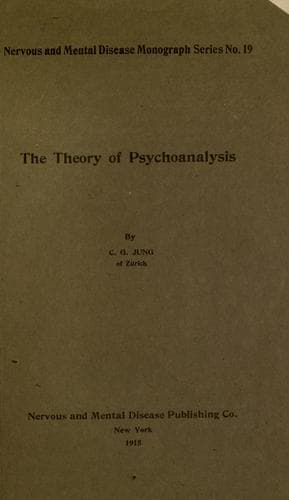
The Theory of PsychoanalysisJung, C. G. (Carl Gustav)
Science
The Theory of Psychoanalysis
Jung, C. G. (Carl Gustav)
Neuroses; Psychoanalysis; Psychology, Pathological; Sex
The technique for the exploration of the unconscious origin is the one I
mentioned before, used before Freud by every scientific man who
attempted to arrive at a psychological understanding of dreams. We try
simply to remember where the parts of the dream arose. The
psychoanalytic technique for the interpretation of dreams is based on
this very simple principle. It is a fact that certain parts of the dream
originate in daily life, that is, in events which, on account of their
slighter importance, would have fallen into oblivion, and indeed were on
the way to become definitely unconscious. It is these parts of the dream
that are the effect of unconscious images and representations. People
have been shocked by this expression also. But we do not conceive these
things so concretely, not to say crudely, as do the critics. Certainly
this expression is nothing but a symbolism taken from conscious
psychology—we were never in any doubt as to that. The expression is
quite clear and answers very well as a symbol of an unknown psychic
fact.
As we mentioned before, we can conceive the unconscious only by analogy
with the conscious. We do not imagine that we understand a thing when we
have discovered a beautiful and rather incomprehensible name. The
principle of the psychoanalytic technique is, as you see,
extraordinarily simple. The further procedure follows on in the same
way. If we occupy ourselves long with a dream, a thing which, apart from
psychoanalysis, naturally never happens, we are apt to find still more
reminiscences to the various different parts of the dream. We are not
however always successful in finding reminiscences to certain portions.
We have to put aside these dreams, or parts of dreams, whether we will
or no.
The collected reminiscences are called the “_dream material_.” We treat
this material by a universally valid scientific method. If you ever have
to work up experimental material, you compare the individual units and
classify them according to similarities. You proceed exactly in the same
way with dream-material; you look for the common traits either of a
formal or a substantial nature.
Certain extremely common prejudices must be got rid of. I have always
noticed that the beginner is looking for one trait or another and tries
to make his material conform to his expectation. This condition I
noticed especially among those colleagues who were formerly more or less
passionate opponents of psychoanalysis, their opposition being based on
well-known prejudices and misunderstandings. When I had the chance of
analyzing them, whereby they obtained at last a real insight into the
method, the first mistake generally made in their own psychoanalytic
work was that they did violence to the material by their own
preconceived opinion. They gave vent to their former prejudice against
psychoanalysis in their attitude towards the material, which they could
not estimate objectively, but only according to their subjective
phantasies.
Public-domain text, read in full here on John Shaqi.
Reviews
Reviews
No reviews yet
Be the first to share your thoughts on this work.
Join the Discussion
Join the discussion
Sign in to leave a comment or review.
Sign InorCreate an account