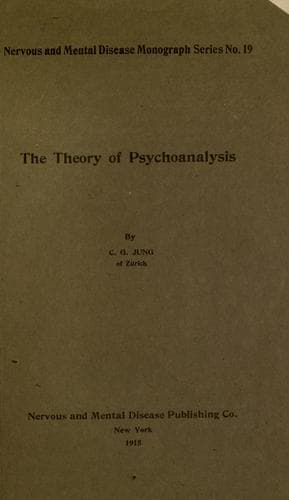
The Theory of PsychoanalysisJung, C. G. (Carl Gustav)
Science
The Theory of Psychoanalysis
Jung, C. G. (Carl Gustav)
Neuroses; Psychoanalysis; Psychology, Pathological; Sex
IV. All the reminiscences of folklore, the superstitious practices must
be remembered, which in any way run parallel with the symbolism of the
baptismal act.
In this way, we get a comparative scientific study of religion as
regards baptism. We accordingly discover the different elements out of
which the act of baptism has arisen. We ascertain further its original
meaning, and we become at the same time acquainted with the rich world
of myths that have contributed to the foundations of religions, and thus
we are enabled to understand the manifold and profound meanings of
baptism. The analyst proceeds in the same way with the dream. He
collects the historical parallels to every part of the dream, even the
remotest, and he tries to reconstruct the psychological history of the
dream, with its fundamental meaning, exactly as in the analysis of the
act of baptism. Thus, through the monographic treatment of the dream, we
get a profound and beautiful insight into that mysterious, fine and
ingenious network of unconscious determination. We get an insight, which
as I said before, can only be compared with the historical understanding
of any act which we had hitherto regarded in a superficial and one-sided
way.
This digression on the psychoanalytic method has seemed to me to be
unavoidable. I was obliged to give you an account of the method and its
position in methodology, by reason of all the extensive
misunderstandings which are constantly attempting to discredit it. I do
not doubt that there are superficial and improper interpretations of the
method. But an intelligent critic ought never to allow this to be a
reproach to the method itself, any more than a bad surgeon should be
urged as an objection to the common validity of surgery. I do not doubt
that some inaccurate descriptions and conceptions of the psychoanalytic
method have arisen on the part of the psychoanalytic school itself. But
this is due to the fact that, because of their education in natural
science it is difficult for medical men to attain a full grasp of
historical or philological method, although they instinctively handle it
rightly.
The method I have described to you, in this general way, is the method
that I adopt and for which I assume the scientific responsibility.
In my opinion it is absolutely reprehensible and unscientific to
question about dreams, or to try to interpret them directly. This is not
a methodological, but an arbitrary proceeding, which is its own
punishment, for it is as unproductive as every false method.
Public-domain text, read in full here on John Shaqi.
Reviews
Reviews
No reviews yet
Be the first to share your thoughts on this work.
Join the Discussion
Join the discussion
Sign in to leave a comment or review.
Sign InorCreate an account