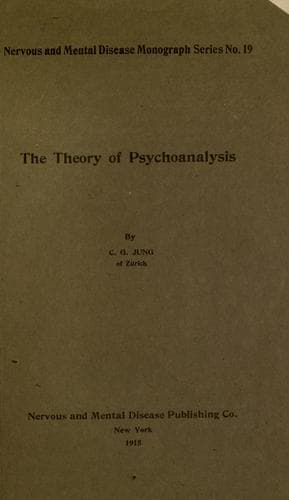
The Theory of PsychoanalysisJung, C. G. (Carl Gustav)
Science
The Theory of Psychoanalysis
Jung, C. G. (Carl Gustav)
Neuroses; Psychoanalysis; Psychology, Pathological; Sex
If one would have the courage to sift dream material, one must not
recoil from any parallel. The dream material generally consists of very
heterogeneous associations, out of which it is sometimes very difficult
to deduce the tertium comparationis. I refrain from giving detailed
examples, as it is quite impossible to handle in a lecture the
voluminous material of a dream. I might call your attention to Rank’s[9]
article in the Jahrbuch, “Ein Traum der sich selber deutet” (A dream
interpreted by itself). There you will see what an extensive material
must be taken into consideration for comparison.
Hence, for the interpretation of the unconscious we proceed in the same
way as is universal when a conclusion is to be drawn by classifying
material. The objection is very often heard: Why does the dream have an
unconscious content at all? In my view, this objection is as
unscientific as possible. Every actual psychological moment has its
special history. Every sentence I pronounce has, beside the intended
meaning known to me another historical meaning, and it is possible that
its second meaning is entirely different from its conscious meaning. I
express myself on purpose somewhat paradoxically. I do not mean that I
could explain every individual sentence in its historical meaning. This
is a thing easier to do in larger and more detailed contributions. It
will be clear to everyone, that a poem is, apart from its manifest
content, especially characteristic of the poet in regard to its form,
its content, and its manner of origin. Although the poet, in his poem,
gave expression to the mood of a moment, the literary historian will
find things in it and behind it which the poet never foresaw. The
analysis which the literary historian draws from the poet’s material is
exactly the method of psychoanalysis.
The psychoanalytic method, generally speaking, can be compared with
historical analysis and synthesis. Suppose, for instance, we did not
understand the meaning of baptism as practised in our churches to-day.
The priest tells us the baptism means the admission of the child into
the Christian community. But this does not satisfy us. Why is the child
sprinkled with water? To understand this ceremony, we must choose out of
the history of rites, those human traditions which pertain to this
subject, and thus we get material for comparison, to be considered from
different standpoints.
I. The baptism means obviously an initiation ceremony, a consecration;
therefore all the traditions containing initiation rites have to be
consulted.
II. The baptism takes place with water. This special form requires
another series of traditions, namely, those rites where water is used.
III. The person to be baptized is sprinkled with water. Here are to be
consulted all those rites where the initiated is sprinkled or submerged,
etc.
Public-domain text, read in full here on John Shaqi.
Reviews
Reviews
No reviews yet
Be the first to share your thoughts on this work.
Join the Discussion
Join the discussion
Sign in to leave a comment or review.
Sign InorCreate an account