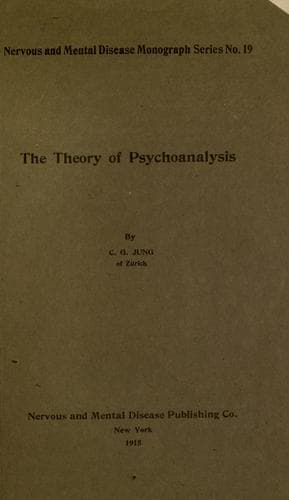
The Theory of PsychoanalysisJung, C. G. (Carl Gustav)
Science
The Theory of Psychoanalysis
Jung, C. G. (Carl Gustav)
Neuroses; Psychoanalysis; Psychology, Pathological; Sex
So far as I know it was really Charcot who, probably under the influence
of Page’s theory of nervous shock, made this observation of theoretical
value. Charcot knew, by means of hypnotism, at that time not understood,
that hysterical symptoms could be called forth by suggestion as well as
made to disappear through suggestion. Charcot believed that he saw
something like this in those cases of hysteria caused by accident, cases
which became more and more frequent. The shock can be compared with
hypnosis in Charcot’s sense. The emotion provoked by the shock causes a
momentary complete paralysis of will-power, during which the remembrance
of the trauma can be fixed as an auto-suggestion. This conception gives
us the original theory of psychoanalysis. Etiological investigation had
to prove whether this mechanism, or a similar one, was also to be found
in those cases of hysteria which could not be called traumatic. This
lack of knowledge of the etiology of hysteria was supplied by the
discovery of Breuer and Freud. They proved that even in those ordinary
cases of hysteria which cannot be said to be caused by shock the same
trauma-element was to be found, and seemed to have an etiological value.
It is natural that Freud, a pupil of Charcot, was inclined to suppose
that this discovery in itself confirmed the ideas of Charcot.
Accordingly the theory elaborated out of the experience of that period,
mainly by Freud, received the imprint of a traumatic etiology. The name
of trauma-theory is therefore justified; nevertheless this theory had
also a new aspect. I am not here speaking of the truly admirable
profoundness and precision of Freud’s analysis of symptoms, but of the
relinquishing of the conception of auto-suggestion, which was the
dynamic force in the original theory, and its substitution by a detailed
exposure of the psychological and psycho-physical effects caused by the
shock. The shock, the trauma, provokes a certain excitation which, under
normal circumstances, finds a natural outlet (“abreagieren”). In
hysteria it is only to a certain extent that the excitation does find a
natural outlet; a partial retention takes place, the so-called blocking
of the affect (“Affecteinklemmung”). This amount of excitation, which
can be compared with an amount of potential energy, is transmuted by the
mechanism of conversion into “physical” symptoms.
Public-domain text, read in full here on John Shaqi.
Reviews
Reviews
No reviews yet
Be the first to share your thoughts on this work.
Join the Discussion
Join the discussion
Sign in to leave a comment or review.
Sign InorCreate an account