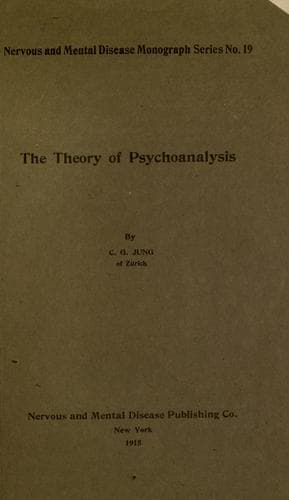
The Theory of PsychoanalysisJung, C. G. (Carl Gustav)
Science
The Theory of Psychoanalysis
Jung, C. G. (Carl Gustav)
Neuroses; Psychoanalysis; Psychology, Pathological; Sex
_The Cathartic Method._—According to this conception, therapy had to
find the means by which those retained emotions could be brought to a
mode of expression, thereby setting free from the symptoms that amount
of repressed and converted feeling. Hence this was called the cleansing,
or _cathartic method_; its aim was to discharge the blocked emotions.
From this it follows that analysis was then more or less closely
concerned with the symptoms, that is to say, the symptoms were
analyzed—the work of analysis began with the symptoms, a method
abandoned to-day. The cathartic method, and the theory on which it is
based, are, as you know, accepted by other colleagues, so far as they
are interested at all in psychoanalysis, and you will find some
appreciation and quotation of the theory, as well as of the method, in
several text-books.
The Traumatic Theory Criticized
Although, as a matter of fact, the discovery of Breuer and Freud is
certainly true, as can easily be proved by every case of hysteria,
several objections can be raised to the theory. It must be acknowledged
that their method shows with wonderful clearness the connection between
the actual symptoms and the shock, as well as the psychological
consequences which necessarily follow from the traumatic event, but
nevertheless, a doubt arises as to the etiological significance of the
so-called trauma or shock.
It is extremely difficult for any critical observer of hysteria to admit
that a neurosis, with all its complications, can be based on events in
the past, as it were on one emotional experience long past. It is more
or less fashionable at present to consider all abnormal psychic
conditions, in so far as they are of exogenic growth, as the
consequences of hereditary degeneration, and not as essentially
influenced by the psychology of the patient and the environment. This
conception is too narrow, and not justified by the facts. To use an
analogy, we know perfectly well how to find the right middle course in
dealing with the etiology of tuberculosis. There are, of course, cases
of tuberculosis where in earliest childhood the germ of the disease
falls upon a soil predisposed by heredity, so that even in the most
favorable conditions the patient cannot escape his fate. None the less,
there are also cases where, under favorable conditions, illness can be
prevented, despite a predisposition to the disease. Nor must we forget
that there are still other cases without hereditary disposition or
individual inclination, and, in spite of this, fatal infection occurs.
All this holds equally true of the neuroses, where matters are not
essentially different in their method of procedure than they are in
general pathology. Neither a theory in which the predisposition is
all-important, nor one in which the influence of the environment is
all-important, will ever suffice. It is true the shock-theory can be
said to give predominance to the predisposition, even insisting that
Public-domain text, read in full here on John Shaqi.
Reviews
Reviews
No reviews yet
Be the first to share your thoughts on this work.
Join the Discussion
Join the discussion
Sign in to leave a comment or review.
Sign InorCreate an account