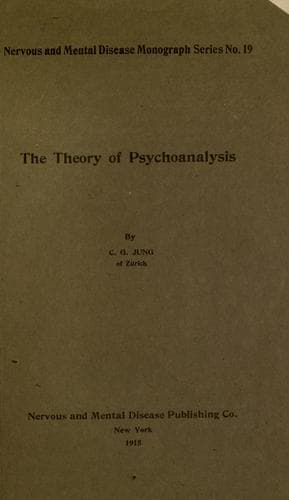
The Theory of PsychoanalysisJung, C. G. (Carl Gustav)
Science
The Theory of Psychoanalysis
Jung, C. G. (Carl Gustav)
Neuroses; Psychoanalysis; Psychology, Pathological; Sex
some past trauma is the condition sine qua non of the neurosis. Yet
Freud’s ingenious empiricism presented even in the “Studies in Hysteria”
some views, insufficiently exploited at the time, which contained the
elements of a theory that perhaps more accentuates the value of
environment than inherited or traumatic predisposition.
The Conception of “Repression”
Freud synthesized these observations in a form that was to extend far
beyond the limits of the shock-theory. This conception is the hypothesis
of repression (“Verdrängung”). As you know, by the word “repression” is
understood the psychic mechanism of the re-transportation of a conscious
thought into the unconscious sphere. We call this sphere the
“unconscious” and define it as the psyche of which we are not conscious.
The conception of repression was derived from the numerous observations
made upon neurotic patients who seemed to have the capacity of
forgetting important events or thoughts, and this to such an extent that
one might easily believe nothing had ever happened. These observations
can be constantly made by anyone who comes into close psychological
relations with his patients. As a result of the Breuer and Freud
studies, it was found that a very special method was needed to call
again into consciousness those traumatic events long since forgotten. I
wish to call attention to this fact, since it is decidedly astonishing
for a priori we are not inclined to believe that valuable things can
ever be forgotten. For this reason several critics object that the
reminiscences which have been called into consciousness by certain
hypnotic processes are only suggested ones, and do not correspond with
reality. Even granting this, it would certainly not be justifiable to
regard this in itself as a condemnation of “repression,” since there are
and have been not a few cases where the fact of repressed reminiscences
can be proved by objective demonstration. Even if we exclude this kind
of proof, it is possible to test the phenomena by experiment. The
association-tests provide us with the necessary experiences. Here we
find the extraordinary fact that associations pertaining to complexes
saturated with emotion emerge with much greater difficulty into
consciousness, and are much more easily forgotten.
As my experiments on this subject were never reëxamined, the conclusions
were never adopted, until just lately, when Wilhelm Peters, a disciple
of Kraepelin, proved in general my previous observation, namely, that
painful events are very rarely correctly reproduced (“die unlustbetonten
Erlebnisse werden am seltensten richtig reproduciert”).
Public-domain text, read in full here on John Shaqi.
Reviews
Reviews
No reviews yet
Be the first to share your thoughts on this work.
Join the Discussion
Join the discussion
Sign in to leave a comment or review.
Sign InorCreate an account