The theory of relativity and its influence on scientific thoughtEddington, Arthur Stanley, Sir
Philosophy
The theory of relativity and its influence on scientific thought
Eddington, Arthur Stanley, Sir
Relativity (Physics); Science -- Philosophy
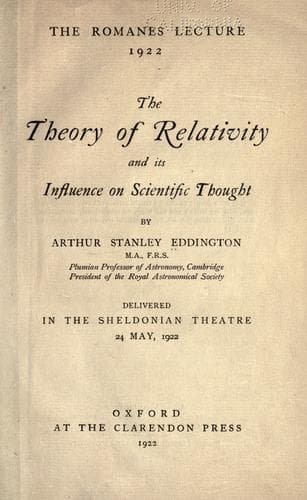
THE ROMANES LECTURE
1922
_THE_
_THEORY OF RELATIVITY_
_and its_
_Influence on Scientific Thought_
BY
ARTHUR STANLEY EDDINGTON
M.A., F.R.S.
_Plumian Professor of Astronomy, Cambridge_
_President of the Royal Astronomical Society_
DELIVERED
IN THE SHELDONIAN THEATRE
24 MAY, 1922
OXFORD
AT THE CLARENDON PRESS
1922
Has not a deeper meditation taught certain of every climate and
age, that the where and the when so mysteriously inseparable
from all our thoughts, are but superficial terrestrial adhesions to
thought?
CARLYLE, _Sartor Resartus_.
Oxford University Press
THE THEORY OF RELATIVITY
In the days before Copernicus the earth was, so it seemed, an immovable
foundation on which the whole structure of the heavens was reared. Man,
favourably situated at the hub of the universe, might well expect that
to him the scheme of nature would unfold itself in its simplest aspect.
But the behaviour of the heavenly bodies was not at all simple; and the
planets literally looped the loop in fantastic curves called epicycles.
The cosmogonist had to fill the skies with spheres revolving upon
spheres to bear the planets in their appointed orbits; and wheels were
added to wheels until the music of the spheres seemed well-nigh drowned
in a discord of whirling machinery. Then came one of the great
revolutions of scientific thought, which swept aside the Ptolemaic
system of spheres and epicycles, and revealed the simple plan of the
solar system which has endured to this day.
The revolution consisted in changing the view-point from which the
phenomena were regarded. As presented to the earth the track of a planet
is an elaborate epicycle; but Copernicus bade us transfer ourselves to
the sun and look again. Instead of a path with loops and nodes, the
orbit is now seen to be one of the most elementary curves--an ellipse.
We have to realize that the little planet on which we stand is of no
great account in the general scheme of nature; to unravel that scheme we
must first disembarrass nature of the distortions arising from the local
point of view from which we observe it. The sun, not the earth, is the
real centre of the scheme of things--at least of those things in which
astronomers at that time had interested themselves--and by transferring
our view-point to the sun the simplicity of the planetary system becomes
apparent. The need for a cumbrous machinery of spheres and wheels has
disappeared.
Public-domain text, read in full here on John Shaqi.
Reviews
Reviews
No reviews yet
Be the first to share your thoughts on this work.
Join the Discussion
Join the discussion
Sign in to leave a comment or review.
Sign InorCreate an account