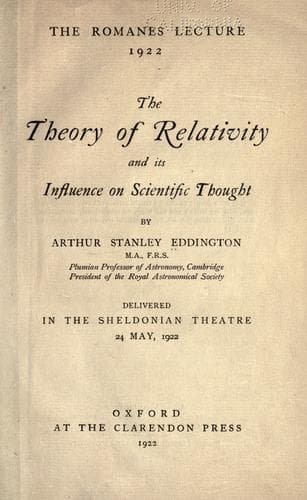
The theory of relativity and its influence on scientific thoughtEddington, Arthur Stanley, Sir
Philosophy
The theory of relativity and its influence on scientific thought
Eddington, Arthur Stanley, Sir
Relativity (Physics); Science -- Philosophy
Every one now admits that the Ptolemaic system, which regarded the earth
as the centre of all things, belongs to the dark ages. But to our dismay
we have discovered that the same _geocentric_ outlook still permeates
modern physics through and through, unsuspected until recently. It has
been left to Einstein to carry forward the revolution begun by
Copernicus--to free our conception of nature from the terrestrial bias
imported into it by the limitations of our earthbound experience. To
achieve a more neutral point of view we have to imagine a visit to some
other heavenly body. That is a theme which has attracted the popular
novelist, and we often smile at his mistakes when sooner or later he
forgets where he is supposed to be and endows his voyagers with some
purely terrestrial appanage impossible on the star they are visiting.
But scientific men, who have not the novelist's licence, have made the
same blunder. When, following Copernicus, they station themselves on the
sun, they do not realize that they must leave behind a certain purely
terrestrial appanage, namely, _the frame of space and time_ in which men
on this earth are accustomed to locate the events that happen. It is
true that the observer on the sun will still locate his experiences in a
frame of space and time, if he uses the same faculties of perception and
the same methods of scientific measurement as on the earth; but the
solar frame of space and time is not precisely the same as the
terrestrial frame, as we shall presently see.
Public-domain text, read in full here on John Shaqi.
Reviews
Reviews
No reviews yet
Be the first to share your thoughts on this work.
Join the Discussion
Join the discussion
Sign in to leave a comment or review.
Sign InorCreate an account