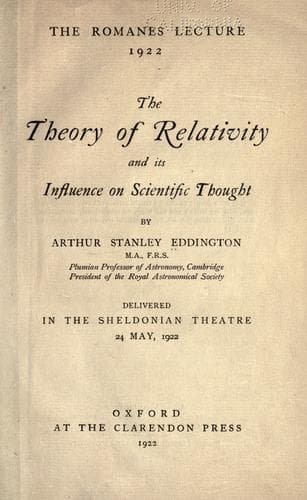
The theory of relativity and its influence on scientific thoughtEddington, Arthur Stanley, Sir
Philosophy
The theory of relativity and its influence on scientific thought
Eddington, Arthur Stanley, Sir
Relativity (Physics); Science -- Philosophy
It is not my purpose to emphasize unduly the superiority of the apple's
view over Newton's, but rather to regard both on an equal footing. I
have perhaps been a little unfair to Newton. His position on the surface
of the earth was unfortunate, but he would have been perfectly content
to be at the centre of the earth, where he could have remained without
support, i.e. without disturbance by molecular bombardment. From there
he would still have observed the well-known acceleration of the apple;
and the apple would have observed a corresponding acceleration of Newton
without any molecular bombardment causing it. From either point of view
there is a mysterious agent at work. How shall we picture to ourselves
this agent? Shall we picture it as a force--a tug of some kind? But if
so, to which of them is the tug applied? If we take the standpoint of
Newton the tug is applied to the apple, if the standpoint of the apple
the tug is applied to Newton; so that in our synthesis of all
standpoints we cannot decide which is being tugged, and the picture of
gravitation as a tugging agent becomes impossible. Einstein replaces it
by a different picture, which we shall perhaps better understand if we
compare it with a very similar revolution of scientific thought which
occurred long ago.
The ancients believed that the earth was flat. The small portion of its
surface with which they were chiefly concerned could be represented
without serious distortion on a flat map. As more distant countries were
added, it would be natural to think that they also could be included in
the flat map. You have all seen such maps of the world, e. g. Mercator's
projection, and you will remember how Greenland appears enormously
exaggerated in size. Now those who adhered to the flat-earth theory must
hold that the flat map gives the _true_ size of Greenland. How then
would they explain that travellers in that country reported that the
distances were much shorter? They would, I suppose, invent a theory that
a demon resided in that country who helped travellers on their way,
making the journeys appear much shorter than they 'really' were. No
doubt the scientists would preserve their self-respect by using some
Graeco-Latin polysyllable instead of the word 'demon', but that must not
disguise from us the fact that they were appealing to a _deus ex
machina_. The name demon is rather suitable, however, because he has the
impish characteristic that we cannot pin him down to any particular
locality. We might equally well start our flat map with its centre in
Greenland; then it would be found that journeys there were quite normal,
and that the activities of the demon were disturbing travellers in
Europe. We now recognize that the true explanation is that the earth's
surface is curved; and the demoniacal complications appeared because we
were forcing the earth's surface into an inappropriate flat frame which
distorts the simplicity of things.
Public-domain text, read in full here on John Shaqi.
Reviews
Reviews
No reviews yet
Be the first to share your thoughts on this work.
Join the Discussion
Join the discussion
Sign in to leave a comment or review.
Sign InorCreate an account