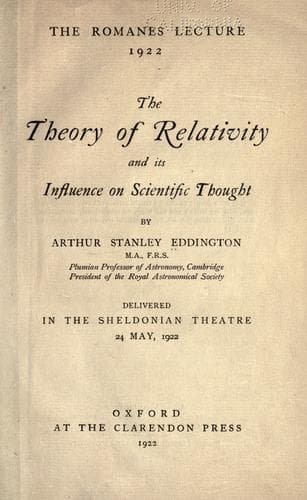
The theory of relativity and its influence on scientific thought — John Shaqi
The theory of relativity and its influence on scientific thoughtEddington, Arthur Stanley, Sir
Philosophy
The theory of relativity and its influence on scientific thought
Eddington, Arthur Stanley, Sir
Relativity (Physics); Science -- Philosophy
We have shown that the contemplation of the world from the standpoint
of a single observer is liable to distort its simplicity, and we have
tried to obtain a juster idea by taking into account and combining
other points of view. The more standpoints the better. Let us now
consider another point of view, which we have not previously thought
about--the point of view of an observer who has tumbled out of an
aeroplane and is falling headlong. In many respects his is an ideal
situation--temporarily. Unfortunately on _terra firma_ we are
continually subjected to a very disturbing influence; we undergo a
terrific bombardment by the molecules of the ground, which are hammering
on the soles of our boots with a total force of some ten stone weight
pressing us upwards. Now our bodies are the scientific appliances which
we use to make our common observations of the world. I am sure that no
physicist would permit any one to enter his laboratory and hammer on his
clocks and galvanometers whilst he was observing with them; at any rate
he would think it necessary to apply some corrections for the effect of
the disturbance. Let us then allow ourselves to fall freely _in vacuo_;
then we shall be free from this disturbing bombardment and able to take
a much more natural view of what is going on around us.
Whilst falling, we perform the experiment of letting go an apple held in
the hand. The apple is now free, but it cannot fall any more than it was
falling already; consequently it remains poised in contact with our
hand. In our new outlook--in our new frame of space and time--an apple
does not drop. There is no mysterious force accelerating it. And
remember that this new frame of space and time is the natural frame of a
free observer; whereas the old frame, in which the mysterious
accelerating force occurred, was the frame of a very much disturbed
observer. It is true that when we look down at the earth we see trees
and houses rushing up to meet us; but there is no mystery about that.
There is an obvious cause for it; plainly they are being propelled
upwards from below by that molecular bombardment which I have mentioned.
You see that the apple's view of things is simpler than Newton's. Newton
had to invent a mysterious force dragging the apple down; the apple
observes only a familiar physical agency propelling Newton up.
Public-domain text, read in full here on John Shaqi.
Reviews
Reviews
No reviews yet
Be the first to share your thoughts on this work.
Join the Discussion
Join the discussion
Sign in to leave a comment or review.
Sign InorCreate an account