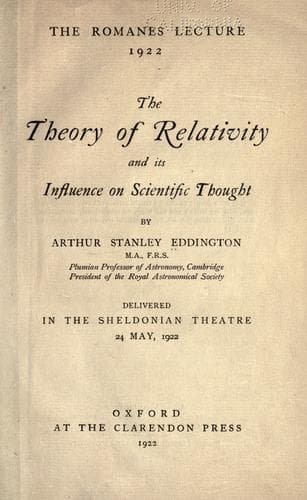
The theory of relativity and its influence on scientific thoughtEddington, Arthur Stanley, Sir
Philosophy
The theory of relativity and its influence on scientific thought
Eddington, Arthur Stanley, Sir
Relativity (Physics); Science -- Philosophy
I think you will readily understand what is meant by a _frame_ of space
and time. It is the system of location to which we appeal when we state,
for example, that one event is 100 miles distant from and 10 hours later
than another. The terms space and time have not only a vague descriptive
reference to a boundless void and an ever-rolling stream, but denote an
exact quantitative system of reckoning distances and time-intervals.
Einstein's first great discovery was that there are many such systems of
reckoning--many possible frames of space and time--exactly on all fours
with one another. No one of these can be distinguished as more
fundamental than the rest; no one frame rather than another can be
identified as the scaffolding used in the construction of the world. And
yet one of them does present itself to us as being the actual space and
time of our experience; and we recoil from the other equivalent frames
which seem to us artificial systems in which distance and duration are
mixed up in an extraordinary way. What is the cause of this invidious
selection? It is not determined by anything distinctive in the frame; it
is determined by something distinctive in us--by the fact that our
existence is bound to a particular planet and our motion is the motion
of that planet. _Nature_ offers an infinite choice of frames; we select
the one in which we and our petty terrestrial concerns take the most
distinguished position. Our mischievous geocentric outlook has cropped
out again unsuspected, persuading us to insist on this terrestrial
space-time frame which in the general scheme of nature is in no way
superior to other frames.
The more closely we examine the processes by which events are assigned
to their positions in space and time, the more clearly do we see that
our local circumstances play a considerable part in it. We have no more
right to expect that the space-time frame on the sun will be identical
with our frame on the earth than to expect that the force of gravity
will be the same there as here. If there were no experimental evidence
in support of Einstein's theory, it would nevertheless have made a
notable advance by exposing a fallacy underlying the older mode of
thought--the fallacy of attributing unquestioningly a more than local
significance to our terrestrial reckoning of space and time. But there
is abundant experimental evidence for detecting and determining the
difference between the frames of differently circumstanced observers.
Much of the evidence is too technical to be discussed here, and I can
only refer to the Michelson-Morley experiment. I fear that some of you
must be getting rather tired of the Michelson-Morley experiment; but
those who go to a performance of Hamlet have to put up with the Prince
of Denmark.
Public-domain text, read in full here on John Shaqi.
Reviews
Reviews
No reviews yet
Be the first to share your thoughts on this work.
Join the Discussion
Join the discussion
Sign in to leave a comment or review.
Sign InorCreate an account