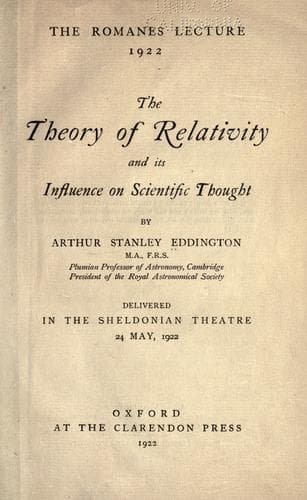
The theory of relativity and its influence on scientific thoughtEddington, Arthur Stanley, Sir
Philosophy
The theory of relativity and its influence on scientific thought
Eddington, Arthur Stanley, Sir
Relativity (Physics); Science -- Philosophy
Maxwell's laws of electromagnetism afford an example of the other type.
These, it is true, are stated as relating to the particular slices of
the world of events, which are served up to us like rashers instant by
instant. But they can be restated, without alteration of effect, in a
form making no reference to slices. This is a very remarkable property
of Maxwell's equations which was quite unknown at the time they were
first put forward. It was brought to light much later by the researches
of Larmor and Lorentz. In consequence of this Einstein is able to take
over the whole classical theory of electromagnetism unaltered; he
restates it so as to show how it applies generally and is not bound up
with the purely terrestrial point of view, but he does not amend the
laws. He metes out different treatment to the gravitational laws and
electromagnetic laws, because he finds the latter already adapted to his
scheme.
If I have succeeded in my object, you will have realized that the
present revolution of scientific thought follows in natural sequence on
the great revolutions at earlier epochs in the history of science.
Einstein's special theory of relativity, which explains the
indeterminateness of the frame of space and time, crowns the work of
Copernicus who first led us to give up our insistence on a geocentric
outlook on nature; Einstein's general theory of relativity, which
reveals the curvature or non-Euclidean geometry of space and time,
carries forward the rudimentary thought of those earlier astronomers who
first contemplated the possibility that their existence lay on something
which was not flat. These earlier revolutions are still a source of
perplexity in childhood, which we soon outgrow; and a time will come
when Einstein's amazing revelations have likewise sunk into the
commonplaces of educated thought.
To free our thought from the fetters of space and time is an aspiration
of the poet and the mystic, viewed somewhat coldly by the scientist who
has too good reason to fear the confusion of loose ideas likely to
ensue. If others have had a suspicion of the end to be desired, it has
been left to Einstein to show the way to rid ourselves of these
'terrestrial adhesions to thought'. And in removing our fetters he
leaves us, not (as might have been feared) vague generalities for the
ecstatic contemplation of the mystic, but a precise scheme of
world-structure to engage the mathematical physicist.
[Footnote 1: The only alternative is that (relatively to a solar
observer) the velocity of light differs in different directions, at
least in the region where the experiment is conducted. This would
presumably be due to some influence of the moving earth on the
propagation of light (convection of the ether). This explanation was at
one time favoured, but it could not be reconciled with the observed
phenomena of the aberration of light.]
Public-domain text, read in full here on John Shaqi.
Reviews
Reviews
No reviews yet
Be the first to share your thoughts on this work.
Join the Discussion
Join the discussion
Sign in to leave a comment or review.
Sign InorCreate an account