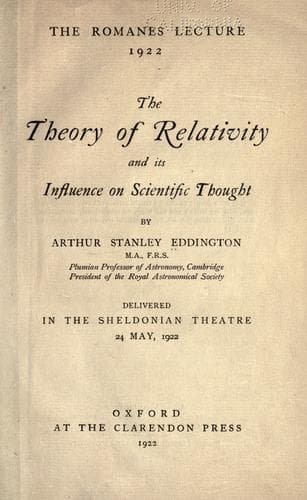
The theory of relativity and its influence on scientific thoughtEddington, Arthur Stanley, Sir
Philosophy
The theory of relativity and its influence on scientific thought
Eddington, Arthur Stanley, Sir
Relativity (Physics); Science -- Philosophy
[Footnote 2: The relativity theory does not suggest that there is such
a thing in nature as a four-dimensional space. The whole object of the
recognition of the four-dimensional world is to eliminate the harassing
frame of space.]
[Footnote 3: The inclination must not exceed a certain limit. This
limiting angle may be regarded as a fundamental constant of the
world-structure, and owing to its fundamental character it appears in
many kinds of phenomena; for example, it determines the velocity of
propagation of light. The instant on the sun which is simultaneous with
a given instant on the earth is indeterminate (varying according to the
space and time frame employed) but only within a range of 16 minutes.
Any event on the sun happening before this 16 minutes is _absolutely_ in
the past, all observers agreeing on this point; in fact it would be
possible for us to have already received a wireless message announcing
its occurrence. Events after the 16 minutes are in the _absolute_
future. The neutral zone which is (absolutely) neither past nor future
becomes proportionately wider as the distance increases; at the nearest
fixed star it extends to 8 years, and at the most distant stars yet
known it reaches 400,000 years.]
[Footnote 4: The three events must not be at the same place since that
would give a time-_line_ not a triangle. The clock must move so that the
two events whose time-distance is to be determined both happen where it
is, just as the scale must be directed so that the two points fall on
it. You are not allowed to 'bend' the clock, i. e. apply force so as to
make it move with other than uniform velocity, any more than you are
allowed to bend the scale by applying force.]
[Footnote 5: Of course, it is not true that _any_ two sides are less
than the third side. A clock, unlike a scale, can only measure in one
direction, viz. from past to future, so that the sides _AB_ + _BC_ and
_AC_ can be chosen in only one way.]
[Footnote 6: This involves only a comparatively trifling generalization
of Euclidean geometry, not to be confused with the 'non-Euclidean'
geometry introduced later in the lecture.]
Public-domain text, read in full here on John Shaqi.
Reviews
Reviews
No reviews yet
Be the first to share your thoughts on this work.
Join the Discussion
Join the discussion
Sign in to leave a comment or review.
Sign InorCreate an account