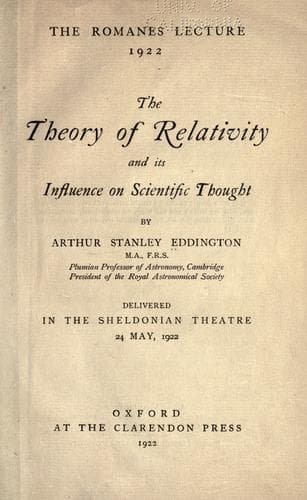
The theory of relativity and its influence on scientific thought — John Shaqi
The theory of relativity and its influence on scientific thoughtEddington, Arthur Stanley, Sir
Philosophy
The theory of relativity and its influence on scientific thought
Eddington, Arthur Stanley, Sir
Relativity (Physics); Science -- Philosophy
[Footnote 7: The following brief outline will give a hint of the nature
of the explanation. Einstein's law of gravitation is usually expressed
as a set of ten very lengthy differential equations; these equations are
exactly equivalent to the geometrical statement that 'the radius of
spherical curvature of any 3-dimensional section of the 4-dimensional
world is a universal constant length, the same for all points of the
world and for all directions of the section'. The law therefore implies
that the world has a certain type of homogeneity and isotropy (not,
however, the _complete_ homogeneity and isotropy of a sphere). To
explain the law of gravitation and the phenomena governed by it, we have
to explain how this isotropy and homogeneity is secured. Our explanation
is that the homogeneity and isotropy is not initially in the external
world, but _in the measurements which we make of it_. It is introduced
in all our operations of measurement, because the appliances which we
use for measurement are themselves part of the world. In the earlier
part of this lecture we saw that the contraction of the arm turned from
horizontal to vertical is not detected by measurements made with a
yard-measure which shares the contraction; in the same way any
anisotropy of the world does not appear in measurements of it by
appliances which, being part of the world, share the same anisotropy.
The law of gravitation therefore arises from the fact that a certain
type of non-homogeneity and non-isotropy of the world cannot come into
observational experience, because it is necessarily eliminated in all
observations and measurements made with material appliances. The orderly
phenomena of gravitation are due to the _absence_ of certain conceivable
effects. We have been trying to find a key to the mystery; but the
secret of the lock lies not in the key but in the wards.]
Public-domain text, read in full here on John Shaqi.
Reviews
Reviews
No reviews yet
Be the first to share your thoughts on this work.
Join the Discussion
Join the discussion
Sign in to leave a comment or review.
Sign InorCreate an account