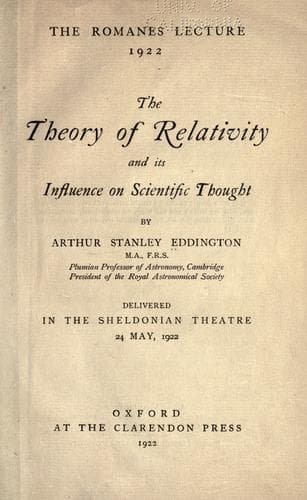
The theory of relativity and its influence on scientific thoughtEddington, Arthur Stanley, Sir
Philosophy
The theory of relativity and its influence on scientific thought
Eddington, Arthur Stanley, Sir
Relativity (Physics); Science -- Philosophy
Take a pair of compasses and twiddle them on a sheet of paper. Is the
resulting curve a circle or an ellipse? Copernicus from his standpoint
on the sun declares that owing to the FitzGerald contraction the two
points drew nearer together when turned in the direction of the earth's
orbital motion; hence the curve is flattened into an ellipse. But here I
think Ptolemy has a right to be heard; he points out that from the
beginning of geometry circles have always been drawn with compasses in
this way, and that when the word 'circle' is mentioned every intelligent
person understands that this is the curve meant. The same pencil line is
in fact a circle in the space of the terrestrial observer and an ellipse
in the space of a solar observer. It is at the same time a moving
ellipse and a stationary circle. I think that illustrates as well as
possible what we mean by _the relativity of space_.
It is sometimes complained that Einstein's conclusion that the frame of
space and time is different for observers with different motions tends
to make a mystery of a phenomenon which is not after all intrinsically
strange. We have seen that it depends on a contraction of moving objects
which turns out to be quite in accordance with Maxwell's classical
theory. But even if we have succeeded in explaining it to ourselves
intelligibly, that does not make the statement any the less true! A new
result may often be expressed in various ways; one mode of statement may
sound less mysterious; but another mode may show more clearly what will
be the consequences in amending and extending our knowledge. It is for
the latter reason that we emphasize the relativity of space--that
lengths and distances differ according to the observer implied. Distance
and duration are the most fundamental terms in physics; velocity,
acceleration, force, energy, and so on, all depend on them; and we can
scarcely make any statement in physics without direct or indirect
reference to them. Surely then we can best indicate the revolutionary
consequences of what we have learnt by the statement that distance and
duration, and all the physical quantities derived from them, do not as
hitherto supposed refer to anything absolute in the external world, but
are relative quantities which alter when we pass from one observer to
another with different motion. The consequence in physics of the
discovery that a yard is not an absolute chunk of space, and that what
is a yard for one observer may be eighteen inches for another observer,
may be compared with the consequences in economics of the discovery that
a pound sterling is not an absolute quantity of wealth, and in certain
circumstances may 'really' be seven and sixpence. The theorist may
complain that this last statement tends to make a mystery of phenomena
of currency which have really an intelligible explanation; but it is a
statement which commends itself to the man who has an eye to the
practical applications of currency.
Public-domain text, read in full here on John Shaqi.
Reviews
Reviews
No reviews yet
Be the first to share your thoughts on this work.
Join the Discussion
Join the discussion
Sign in to leave a comment or review.
Sign InorCreate an account